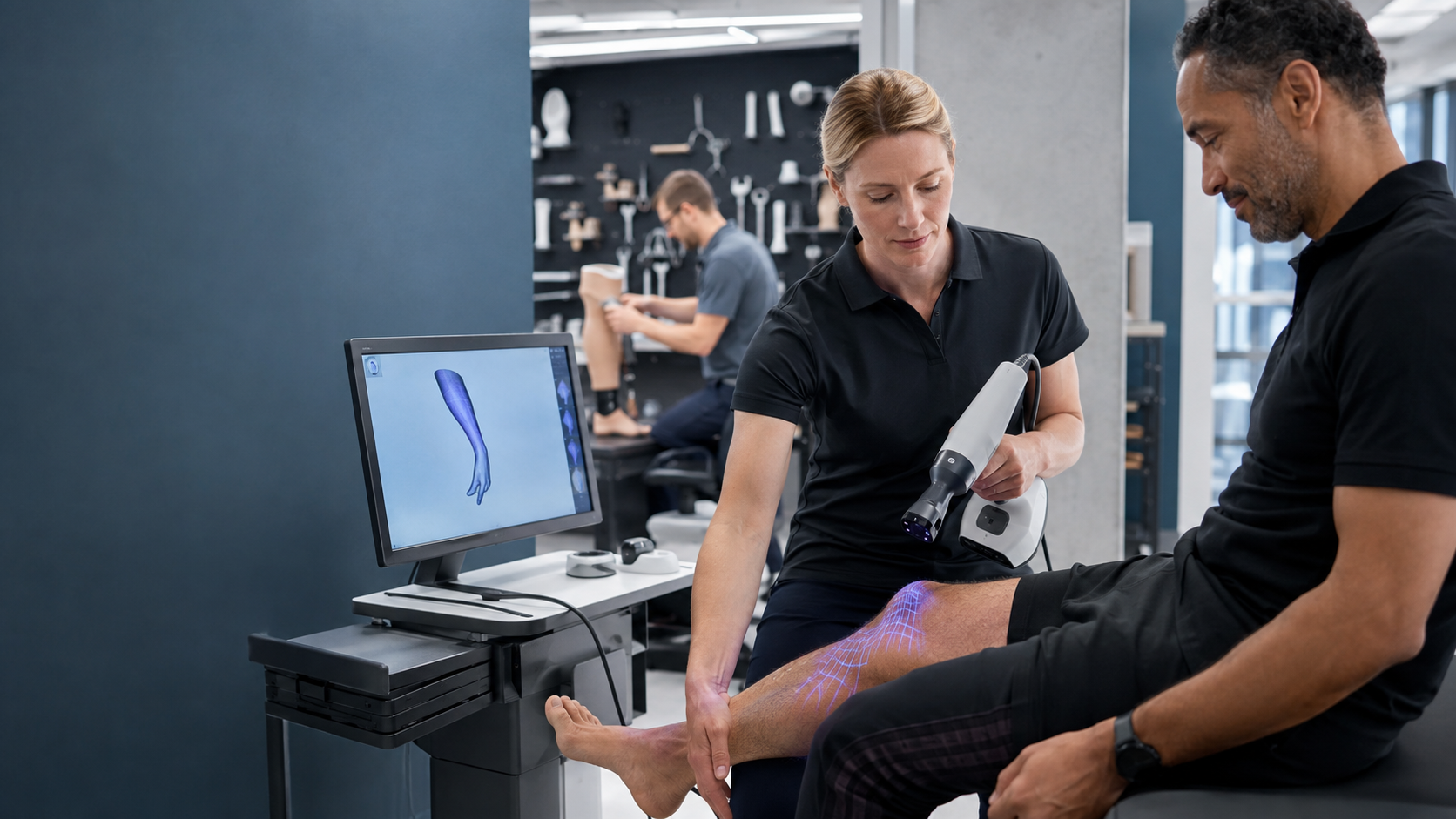
Digital Scanning and the Changing P&O Worklab
Digital scanning can capture shape efficiently, preserve files and connect clinical assessment with computer-aided design. Its value, however, depends on how accurately the team records anatomy, correction and clinical intent.
What scanning can improve
A good digital record supports repeatability, remote collaboration, comparison over time and reduced storage of physical models. It may shorten selected production steps and allows designs to be reviewed before carving, milling or additive manufacturing.
A scan is not an assessment
A scanner records surface geometry. It does not independently identify pain, tissue tolerance, joint flexibility, muscle power, gait deviation or the correction a patient can accept. Landmarks, loading conditions and desired alignment must still be defined by a qualified clinician.
The worklab is changing
Technicians increasingly need skills in file handling, digital rectification, version control, design constraints and machine preparation alongside traditional material knowledge and finishing skills. Conventional methods remain important for verification, adjustment, repair and cases where scanning is unsuitable.
Common failure points
- Movement or incomplete surface capture.
- Poor landmark marking or inconsistent patient position.
- Loss of intended correction between scan and design.
- Confusing left/right, patient or file versions.
- Assuming software defaults equal clinical prescription.
- Manufacturing without an agreed quality-control checkpoint.
A strong hybrid workflow
- Complete the clinical assessment and define goals.
- Prepare the patient position and mark landmarks.
- Capture and inspect the scan before the patient leaves.
- Attach clinical notes and correction instructions to the same case record.
- Review the digital model jointly when complexity warrants it.
- Validate the manufactured device through fitting and functional assessment.
Conclusion
Digital scanning is most powerful when it strengthens—not separates—the relationship between clinic and worklab. Technology can improve consistency, but skilled people, clear communication and patient-specific verification remain the foundation.
This blog is technology-neutral and does not endorse a particular scanner, software platform or manufacturing method.