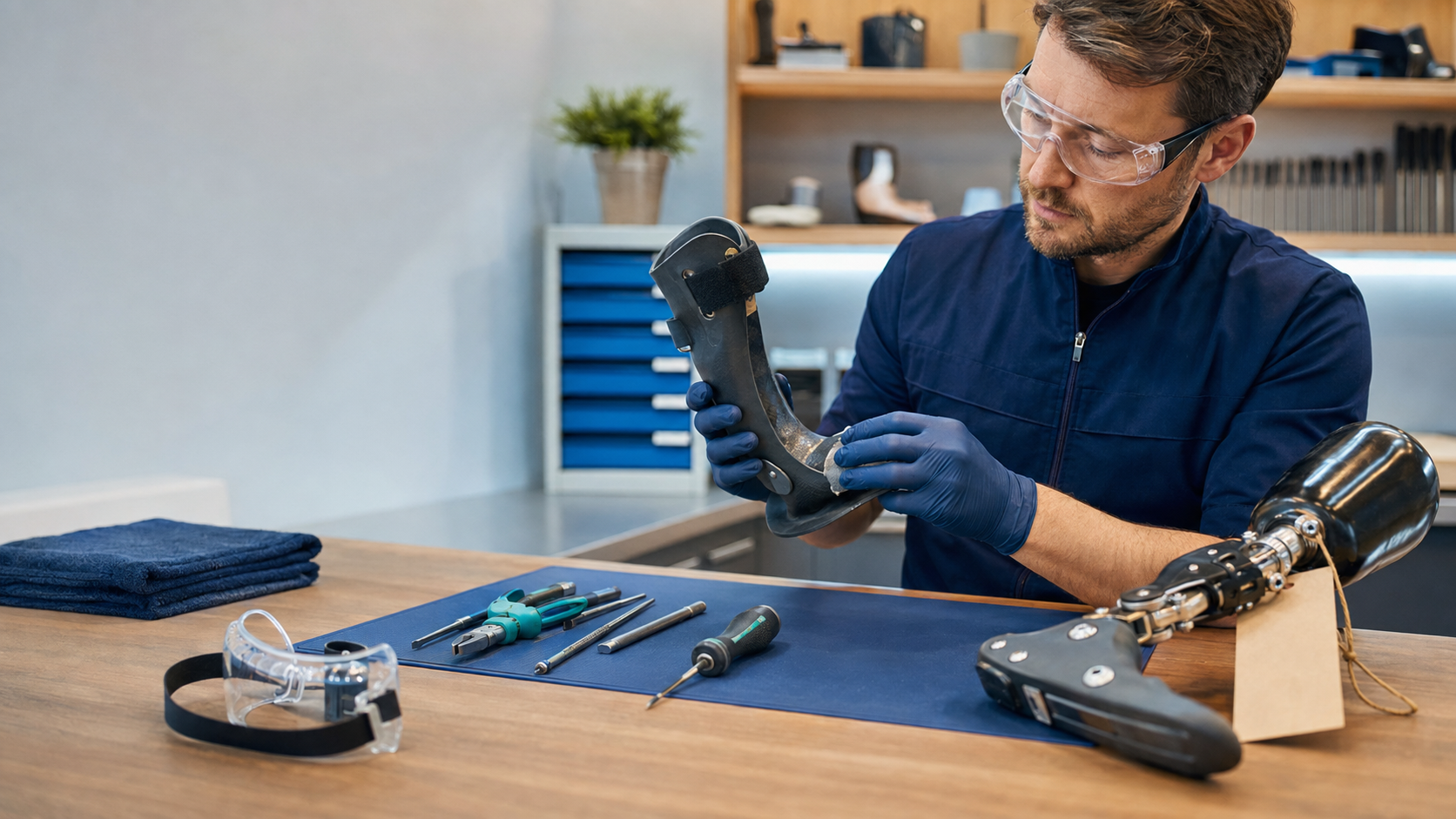
Managing Orthotic and Prosthetic Repairs and Device Breakage Safely
When an orthosis or prosthesis cracks, loosens or stops functioning, pressure to “fix it quickly” can bypass essential checks. A controlled repair pathway protects the patient, clinician, technician and organization.
Start with triage
Identify the device, user, failure, timing and circumstances. Ask whether a fall, injury, skin problem or sudden functional change occurred. Structural failure, joint malfunction, loss of suspension or sharp broken edges may require immediate discontinuation and a safe alternative mobility plan.
Do not repair blindly
The visible break may be the result rather than the cause. Review fit, alignment, material fatigue, body-weight or activity change, component compatibility and previous repairs. Photographs and the original work order help establish what changed.
A controlled repair workflow
- Register and label the device with patient and job identifiers.
- Record the complaint, failure location and device condition.
- Perform clinical and technical assessment.
- Define whether repair is safe, temporary, permanent or contraindicated.
- Obtain approval and informed consent where risk or limitation exists.
- Use compatible materials and manufacturer instructions where applicable.
- Complete quality control, fitting and functional verification.
- Document the work, advice, limitations and follow-up.
When replacement is safer
Replacement may be preferable when the base material is extensively fatigued, repeated failure has occurred, the device no longer fits, essential parts are obsolete, or a repair would conceal damage without restoring structural integrity. A repair should never create false confidence.
Release only after verification
Check edges, fasteners, joints, alignment, suspension and patient comfort. The clinician should confirm that the device performs its intended function. Explain warning signs and give a realistic follow-up plan.
Conclusion
Speed matters, but controlled speed is the goal. Good triage and traceability allow urgent repairs to move quickly without replacing professional judgment with improvisation.
This professional blog is educational. Repairs must follow organizational procedures, applicable manufacturer guidance and qualified clinical oversight.