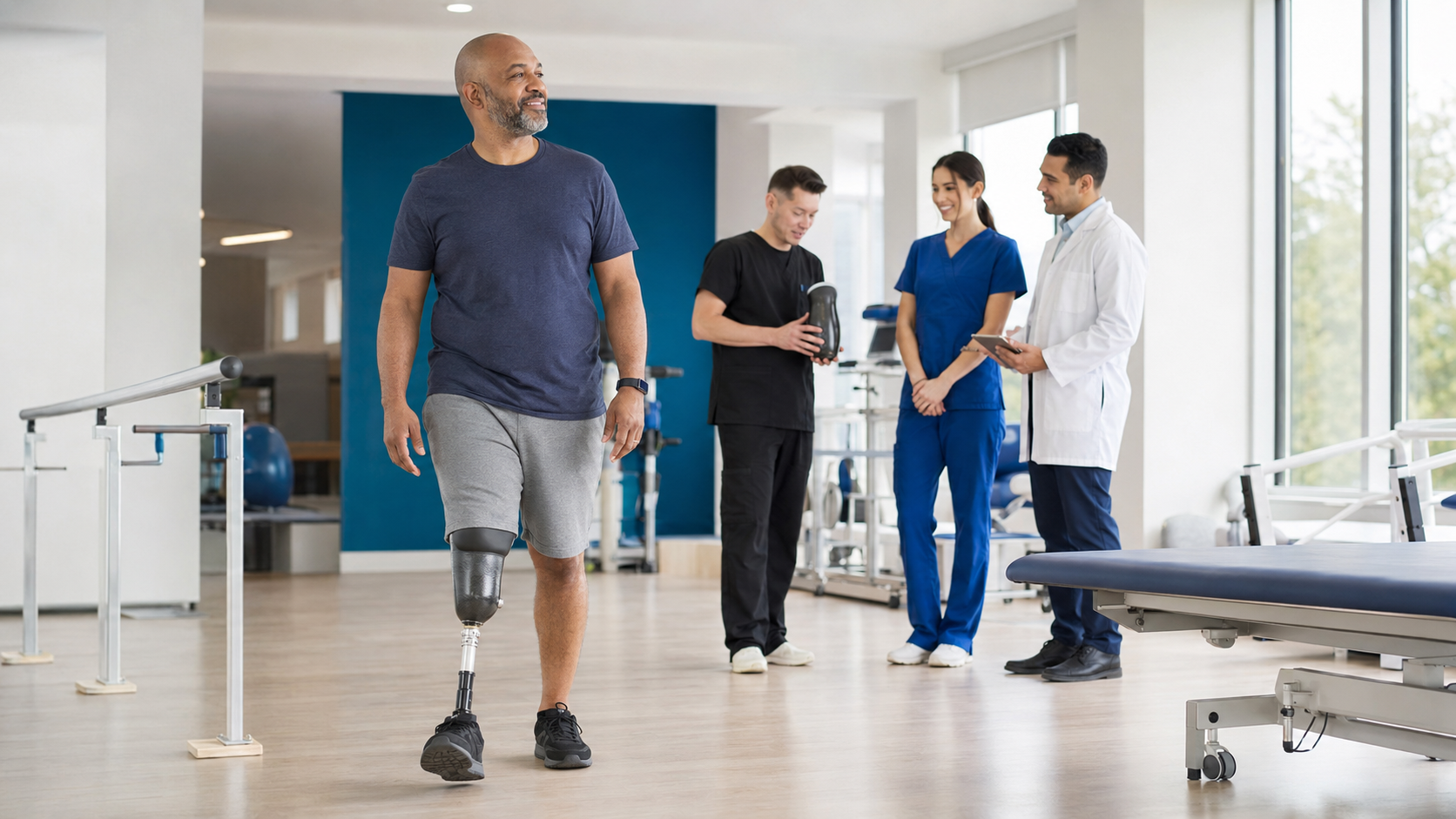
Multidisciplinary Amputee Rehabilitation: From Surgery to Community Reintegration
Amputation rehabilitation is not a single appointment and a prosthesis is not the entire treatment. The best outcomes develop through coordinated decisions made before surgery, during wound healing, throughout prosthetic rehabilitation and after the person returns to family, work and community life.
A continuum rather than separate services
Each stage influences the next. Surgical level and soft-tissue management affect prosthetic options. Early positioning and exercise influence contracture risk. Residual-limb volume, skin condition and pain affect socket tolerance. Home access, confidence, cognition, work demands and family support affect whether technical gains become real participation.
Who contributes to the rehabilitation team?
The exact team depends on the person and service setting, but may include the surgeon, rehabilitation physician, nurses, prosthetist, physiotherapist, occupational therapist, psychologist or counsellor, social worker, wound-care specialist, dietitian, podiatrist and peer-support representative. The patient and family remain central members of the team.
- Medical and surgical team: manages disease, healing, pain, infection risk and surgical considerations.
- Prosthetist: evaluates prosthetic candidacy, designs the socket and components, manages alignment, fit and follow-up.
- Physiotherapist: develops strength, range, balance, transfers, gait and endurance.
- Occupational therapist: addresses self-care, upper-limb function, home tasks, work and environmental adaptation.
- Psychosocial team: supports adjustment, body image, mood, family roles, finances and community participation.
Stage 1: Before amputation, when possible
Pre-amputation consultation allows the team to understand the cause of limb loss, comorbidities, previous mobility, cognition, home environment and personal priorities. The patient can learn about likely functional implications, mobility with or without a prosthesis, rehabilitation timeframes and equipment needs. Prosthetic candidacy should never be reduced to age alone; health, goals, healing potential, balance, strength, cognition and expected benefit all matter.
Stage 2: Early postoperative and pre-prosthetic rehabilitation
Priorities include wound protection, pain management, edema control, prevention of joint contracture, safe transfers and maintenance of strength and cardiovascular capacity. Residual-limb care may include clinically selected dressings or compression, desensitization and skin education. The person should also learn wheelchair skills and safe non-prosthetic mobility because every prosthesis user needs an alternative mobility plan.
Phantom sensations are common. Phantom limb pain and residual-limb pain should be assessed rather than dismissed. Persistent or severe pain, wound breakdown, infection signs, vascular concerns or unexpected swelling require medical review.
Stage 3: Prosthetic assessment and prescription
Prescription is a shared clinical decision. The team considers amputation level, residual-limb condition, range of motion, strength, balance, sensation, body weight, activity goals, environment and ability to manage the device. Component selection should match actual needs rather than technology for its own sake.
The socket is the human–device interface. Comfort, pressure distribution, suspension, control and skin tolerance must be reviewed together. A technically advanced knee or foot cannot compensate for an unsafe or poorly tolerated socket.
Stage 4: Prosthetic training
Training usually progresses from donning and doffing, skin checks and weight transfer to standing balance, level walking, turning, ramps, stairs, uneven surfaces and community tasks. Safe falling and floor-recovery strategies may be taught when appropriate. Training should include energy conservation and realistic wearing schedules.
Outcome measures can help the team track mobility, balance confidence, walking capacity, pain, device use and patient-reported participation. Results should guide decisions rather than function as paperwork alone.
Stage 5: Reintegration and lifelong follow-up
Community reintegration may include returning to education, employment, parenting, driving, sport, religious activities and social roles. Environmental barriers and stigma can be as limiting as physical impairment. Workplace assessment, reasonable adaptations, peer support and accessible transport may therefore be essential rehabilitation interventions.
Follow-up continues after discharge. Residual-limb volume, body weight, strength, health and goals change. The prosthesis requires inspection, maintenance and timely adjustment. New pain, repeated falls, skin injury, loss of suspension or reduced function should prompt review.
What good coordination looks like
- A shared problem list and patient-defined goals.
- Clear responsibility for each action and referral.
- Consistent information across clinic, therapy and worklab.
- Documented changes to fit, alignment, mobility and skin tolerance.
- Planned follow-up and a clear route back when problems arise.
Conclusion
Successful amputee rehabilitation is measured not only by healing or walking distance but by safety, independence, confidence and participation in a life that matters to the individual. Coordinated teamwork protects continuity, reduces avoidable delays and keeps the prosthesis connected to the wider purpose of rehabilitation.
Selected references
- VA/DoD Clinical Practice Guideline for Rehabilitation of Individuals with Lower Limb Amputation (2024/2025)
- WHO standards for prosthetics and orthotics
- CDC: Recovering from a diabetes-related amputation
Clinical note: This educational article does not replace individualized medical, surgical, therapy or prosthetic assessment.