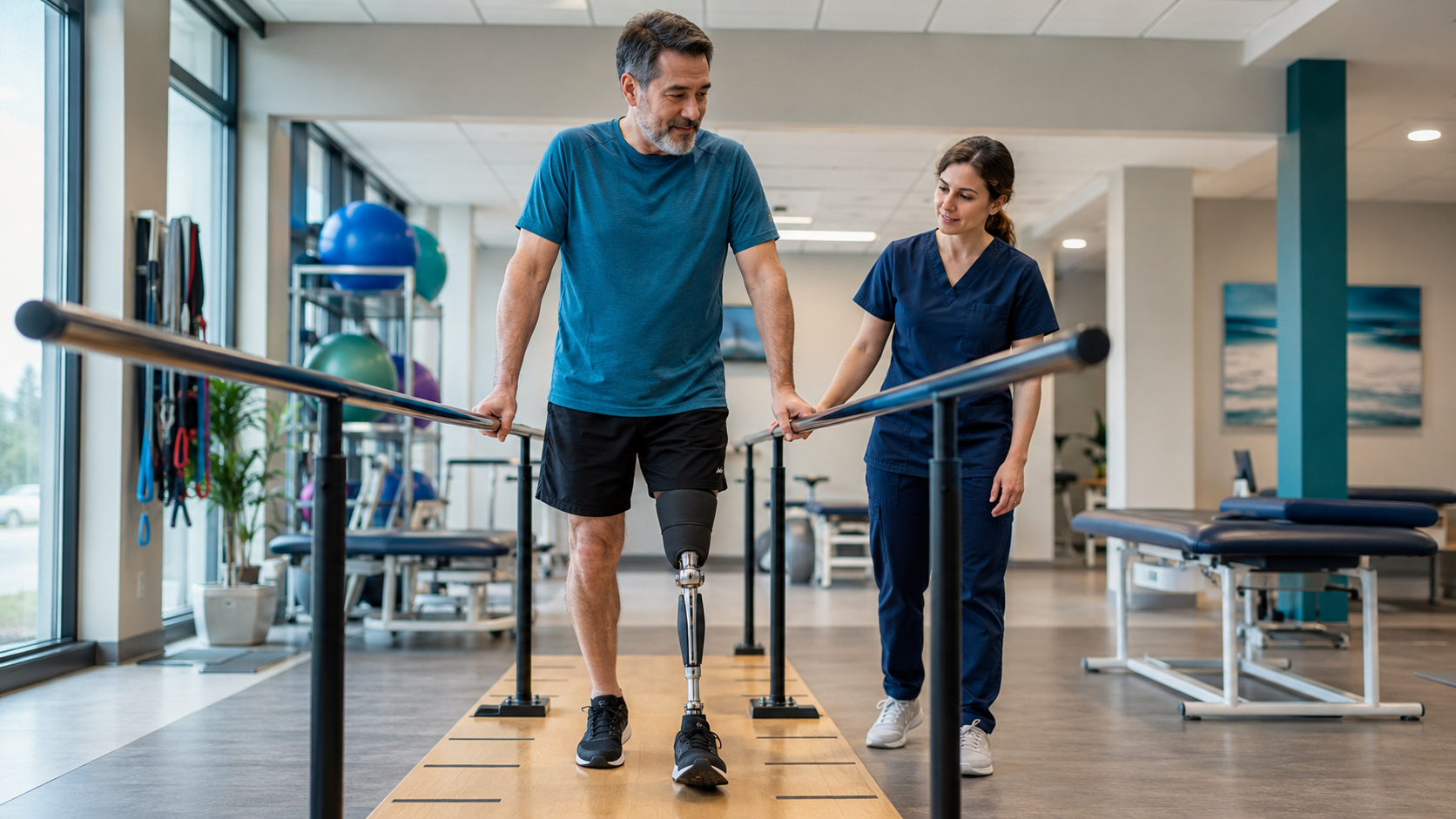
Preventing Falls in Lower-Limb Prosthesis Users
Falls and fear of falling can restrict mobility, confidence and participation after lower-limb amputation. Prevention requires more than telling someone to “be careful.” It requires a structured review of the person, prosthesis, task and environment.
Why fall risk can increase
Limb loss changes sensory feedback, base of support and the mechanics used to recover from a trip or loss of balance. Risk may rise further with muscle weakness, reduced joint range, pain, poor vision, vestibular problems, neuropathy, medication effects, cognitive difficulty or cardiovascular disease.
Prosthetic factors can also contribute: socket discomfort, loss of suspension, pistoning, alignment changes, inappropriate component settings, worn footwear, damaged components or a device that no longer matches the person’s function.
Ask about the circumstances
A useful review looks beyond the number of falls. Where did it happen? Was the person turning, stepping backward, rising from a chair, walking on a slope or carrying something? Was the prosthesis worn? Did the knee buckle, toe catch or socket move? Were dizziness, fatigue, pain or poor lighting involved?
Clinical assessment
Assessment may include medical review, vision and medication screening, residual-limb and contralateral-foot examination, joint range, strength, sensation, balance, transfers, gait and functional tasks. Standardized measures—selected for the individual and setting—can support monitoring. Examples include the Timed Up and Go, Four Square Step Test, Berg Balance Scale, Activities-specific Balance Confidence Scale and amputee-specific mobility measures.
No single score explains every fall. Results should be interpreted alongside observation, patient report and real-world task demands.
Prosthetic review
- Check skin condition, residual-limb volume and socket comfort.
- Confirm suspension and control; investigate pistoning or rotation.
- Inspect liners, sleeves, locks, straps, joints and fasteners.
- Review static and dynamic alignment.
- Check prosthetic height and the condition and consistency of footwear.
- Confirm that component settings suit current strength, cadence and environment.
Users should not attempt structural repairs or alignment changes themselves. A loose, cracked or malfunctioning device should be taken out of use and assessed promptly.
Training for safer mobility
Individualized physiotherapy may address strength, flexibility, weight transfer, stepping reactions, dual-task walking, turning, obstacles, slopes and uneven terrain. Practice should progress safely from controlled conditions to the person’s actual environment. Appropriate walking aids are tools for independence, not signs of failure.
Where clinically suitable, the rehabilitation team may teach how to respond to balance loss, how to get up from the floor and how to summon help. Family members may also need instruction in safe assistance.
Home and community strategies
- Improve lighting, especially between bed and bathroom.
- Remove loose rugs, cables and clutter from walking routes.
- Use secure handrails and non-slip bathroom surfaces.
- Choose stable, well-fitting footwear and avoid unapproved heel-height changes.
- Keep frequently used items within easy reach.
- Plan for wet floors, curbs, crowds and fatigue.
- Carry a phone or alert device when appropriate.
Fear of falling matters
Fear may lead to avoiding activity, which can reduce strength and confidence and increase future risk. The answer is not unsafe exposure or complete restriction. Graded practice, achievable goals, psychological support and peer experience can help restore confidence.
When urgent review is needed
Seek urgent medical assessment after a fall involving head injury, loss of consciousness, severe pain, suspected fracture, new neurological symptoms or inability to bear weight. Stop prosthesis use and contact the clinical team for new skin breakdown, sudden socket instability, component failure or repeated unexplained knee buckling.
A practical prevention plan
- Record falls and near-falls, including the task and location.
- Review medical, physical, prosthetic and environmental contributors.
- Correct device fit, alignment or maintenance problems.
- Train the specific activities that create difficulty.
- Modify the environment and agree on an emergency plan.
- Reassess after health, weight, medication, activity or prosthetic changes.
Conclusion
Fall prevention works best when it is proactive and multidisciplinary. Listening to the user’s experience, examining the prosthesis and practicing meaningful tasks can protect safety without unnecessarily limiting independence.
Selected references
- VA/DoD lower-limb amputation rehabilitation guideline
- Clinical evaluation of fall risk in older adults who use lower-limb prostheses
- Prevalence, risk factors and fear of falling among lower-limb amputees
Clinical note: This article provides general education and does not replace assessment by the person’s medical and rehabilitation team.