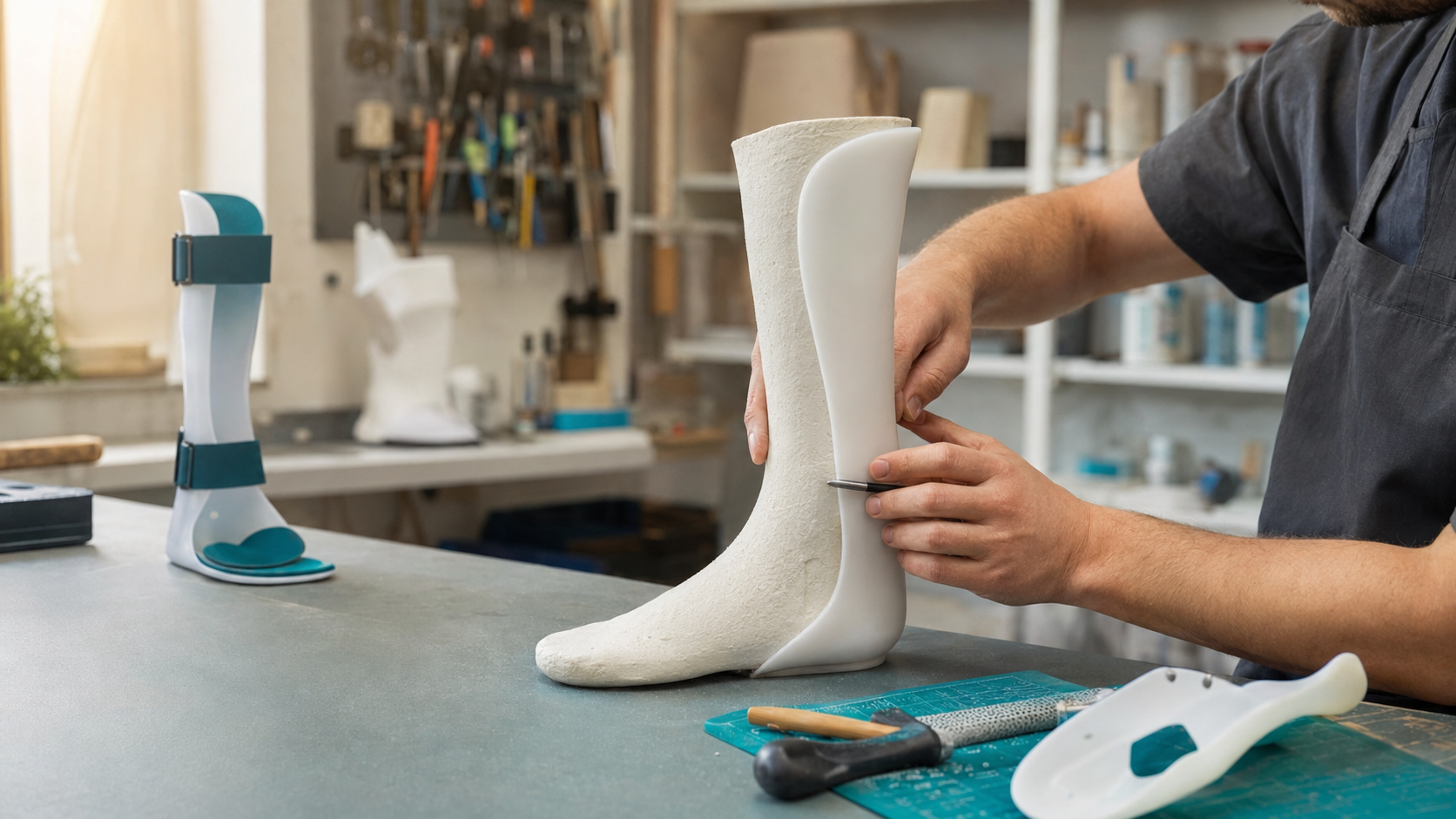
Behind the Workshop: The Custom AFO Fabrication Process
A custom AFO begins with a clinical question: what movement should be controlled, assisted or permitted? The workshop’s job is to translate that prescription into a comfortable, durable device whose mechanical behaviour matches the patient’s needs.
Every stage affects the final outcome. A small error in alignment, model correction, trimlines or finishing can change comfort and function.
1. Clear Clinical Information
A useful work order includes diagnosis, muscle strength, range, tone, alignment, weight, activity, skin risks, footwear and the intended ankle and knee effect. The fabrication team should clarify missing information before starting.
2. Capturing Shape and Alignment
The limb may be captured by casting or scanning. Landmarks, pressure-sensitive areas and correction forces are recorded. The position must reflect the achievable and prescribed alignment—not simply the resting posture.
3. Positive Model Rectification
On a plaster or digital model, the technician establishes total contact, adds relief over vulnerable anatomy and builds corrective contours. Rectification must preserve anatomical volume while creating the surfaces needed for three-point pressure systems and control.
4. Material and Design Planning
PPH, PPC, copolymer, EVA, Plastazote or composites are selected according to stiffness, flexibility, weight, skin, adjustability and loading. Thickness, trimlines, footplate length, reinforcement and joint selection together determine how the AFO behaves.
5. Forming
For thermoplastic fabrication, controlled heating and vacuum forming help produce uniform contact and avoid thinning, webbing or bubbles. Correct draping and cooling are essential. Composite work requires controlled lamination, fiber orientation, resin handling and safety procedures.
6. Trimming and Finishing
Trimlines are marked from the prescription and modified conservatively. Edges are smoothed, transitions are blended, straps are positioned for effective control and any lining is bonded without ridges. The device is then inspected for cracks, sharp edges, weak areas and asymmetry.
7. Clinical Fitting
The orthotist checks donning, total contact, pressure, ankle position, footwear and the effect during standing and gait. Adjustments are based on both observation and patient feedback. A clean bench result is not enough; the device must work on the person.
8. Delivery and Follow-Up
The user receives instructions on wearing time, skin checks, socks, footwear, cleaning and warning signs. Follow-up matters because movement, growth, swelling, wear and functional goals can change.
My Workshop Reflection
Good AFO fabrication is a conversation between clinical reasoning and skilled hands. When clinicians and technicians communicate clearly, problems are identified earlier, rework is reduced and the patient receives a safer, more effective device.
No patient-identifying information is included. Fabrication must follow qualified prescriptions, manufacturer data and local safety procedures.