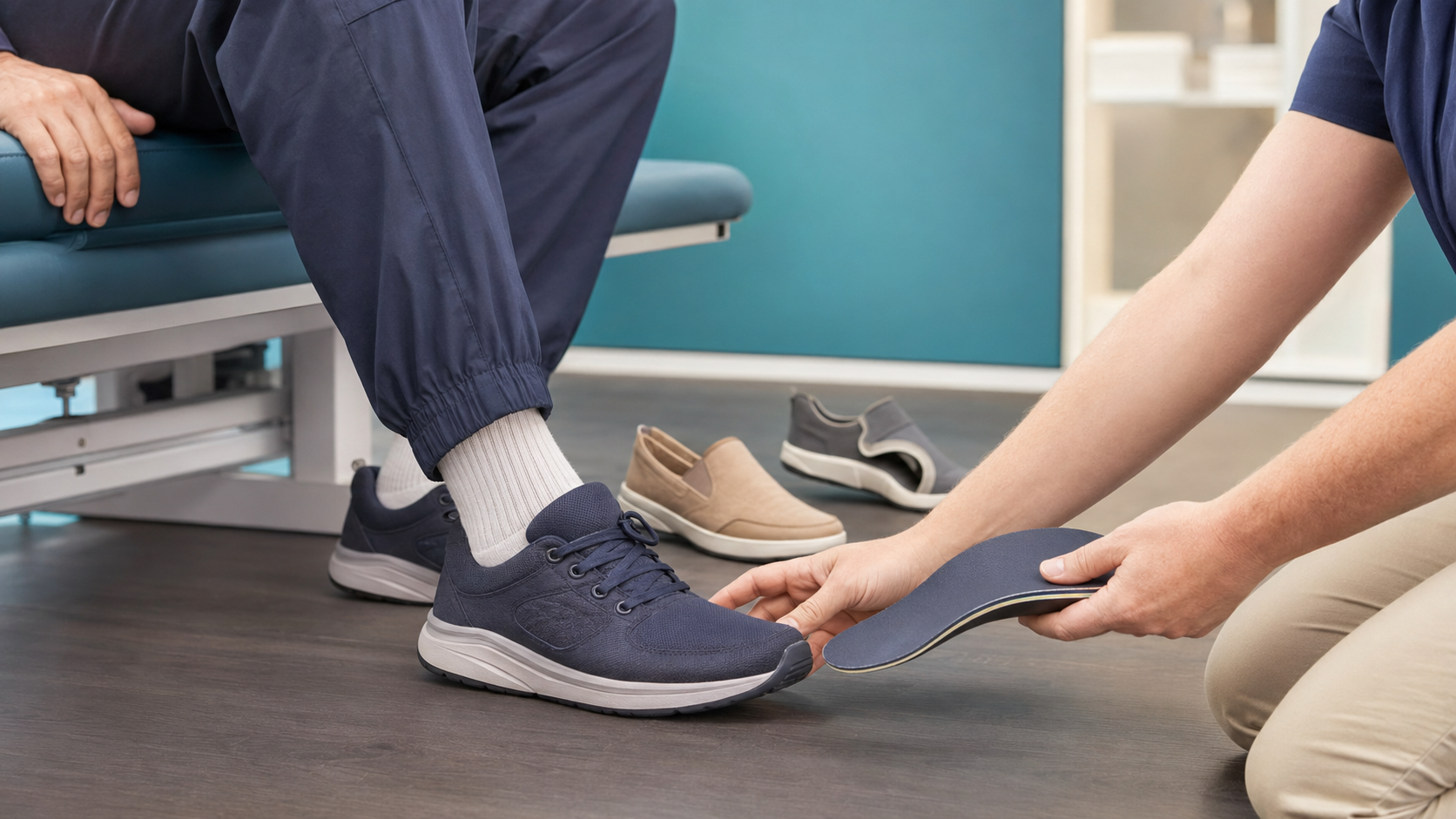
The Shoe Is Part of the Treatment: Why Insole Fitting Should Never Be Assessed Alone
In clinical and workshop practice, an insole can be beautifully shaped, correctly posted and carefully finished—and still fail when it is placed inside the wrong shoe. The shoe controls the space around the foot, the stability under the device and the position in which the insole meets the body. This is why the final fitting should never stop at checking the insole on the examination table.
We do not deliver an insole alone. We deliver a shoe–insole system that must work during the patient’s real daily activities.
The Same Insole Can Behave Differently
Move one insole between a stable lace-up shoe, a narrow fashion shoe and a loose slip-on, and its apparent function can change. The narrow shoe may distort the forefoot. The shallow shoe may lift the heel. The slip-on may allow the foot to move away from the intended arch and heel position. The insole has not changed, but its working environment has.
Why the Actual Shoes Should Attend the Appointment
Patients should bring the footwear they use for work, walking and daily activity. This allows the clinician to check available depth, internal length, width, fastening, sole stability, wear and the original liner. It also reveals practical problems that measurements alone may miss.
- Does the insole sit flat without curling?
- Can the foot enter without forcing or folding the shoe?
- Does the heel remain secure after fastening?
- Is there adequate width and toe space?
- Does the patient walk differently in this shoe?
- Is the shoe itself worn, unstable or unsuitable?
Trimming Is Not Always the Solution
When an insole does not fit, the first response is sometimes to trim it until it enters the shoe. Minor finishing may be appropriate, but repeated trimming can remove support, shorten the heel seat or change the relationship between the foot and the corrective elements. If the shoe is fundamentally too narrow or shallow, changing the shoe is often the safer solution.
The Original Liner Can Create Hidden Problems
Placing a prescribed insole on top of a thick factory liner raises the foot and reduces internal depth. The result may be heel slippage, tight laces, toe pressure or an unstable fit. When intended by the design, the removable liner should be taken out and the base checked before the new insole is inserted.
Communication at Delivery
Patients need practical guidance, not only a device. They should understand which shoes are suitable, how to move the insole, whether the original liner should be removed, how to fasten the shoe and what warning signs require review. If the insole is transferred between shoes, each shoe should be compatible rather than assumed to be suitable.
A Common Workshop Lesson
When a patient reports that an insole is uncomfortable, the device may not be the only cause. Before adding, grinding or remaking, inspect the complete system: foot, insole, sock, shoe and walking pattern. A worn shoe, folded liner or tight upper may explain the complaint more accurately than the insole alone.
People with diabetes, neuropathy or previous ulceration require particularly careful shoe–insole fitting and skin monitoring. A pressure problem should not be managed through unsupervised padding or shoe stretching.
My Professional Reflection
Insole quality is not defined only at the workbench. It is defined when the patient stands and walks in the footwear used in real life. Including shoes in assessment, fabrication information, fitting and follow-up prevents avoidable modifications and keeps the technical work connected to the clinical purpose.
The shoe is not an accessory to the treatment. It is part of the treatment.
This blog shares general professional experience and does not identify any patient, workplace or organization.