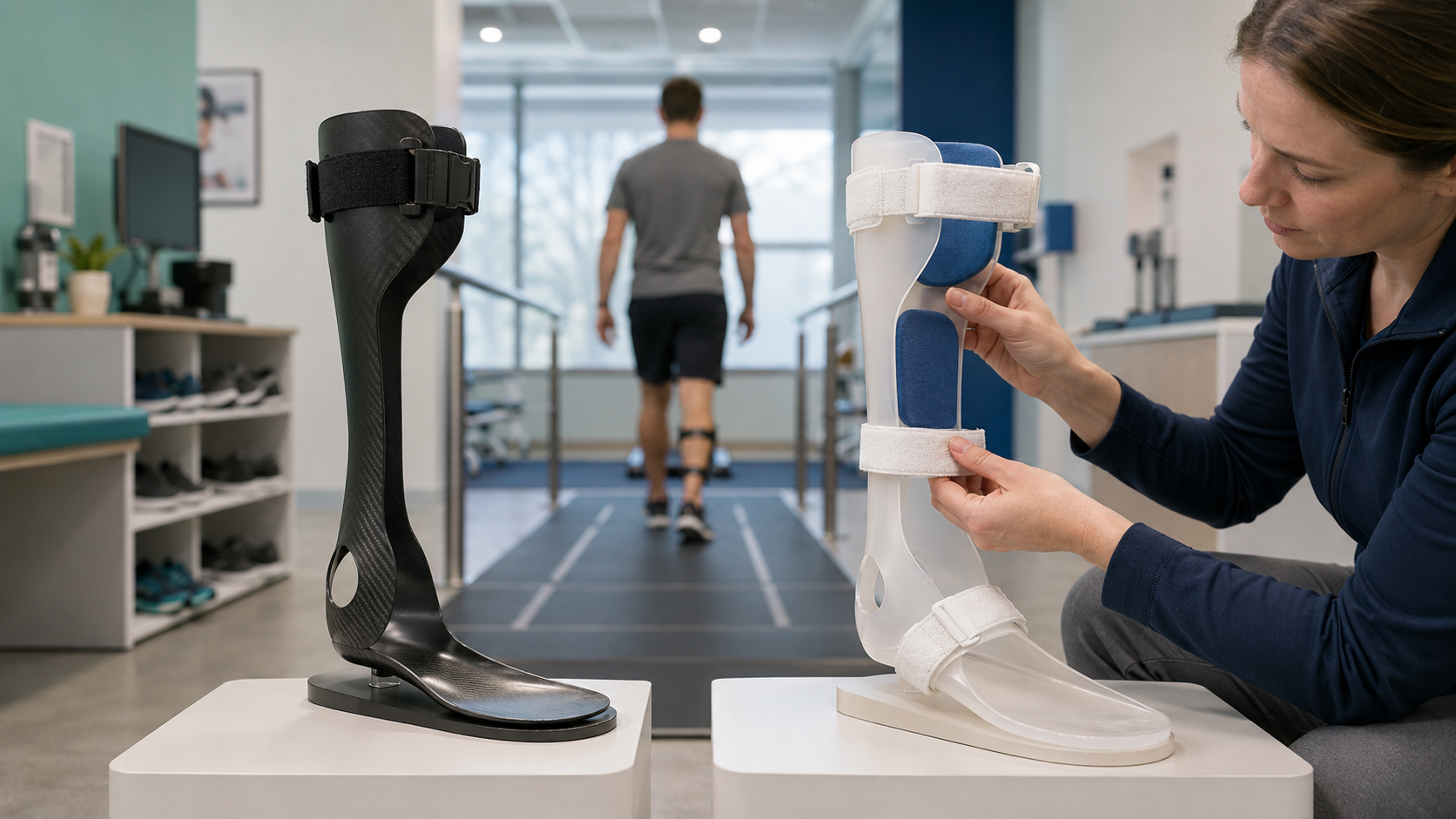
Allard Carbon-Composite AFOs vs Traditional PPC/PPH AFOs: Indications, Contraindications, Comfort and Patient Satisfaction
Dynamic carbon-composite AFOs and traditional custom thermoplastic AFOs can both improve walking, but they are not interchangeable solutions. Allard’s anterior-shell AFO family includes models with different rigidity and stability, while PPC or PPH AFOs can be fabricated in many custom designs. The clinically relevant question is not which material looks more modern—it is which complete orthotic system provides appropriate control with acceptable comfort and reliable daily use.
The best AFO is the one that safely achieves the functional goal and that the patient can wear consistently. Comfort, skin tolerance, footwear compatibility and confidence often influence satisfaction more than cosmetic appearance.
Understanding the Two Categories
Allard Carbon-Composite AFOs
Allard manufactures several prefabricated carbon-composite AFO models, including Ypsilon, ToeOFF and BlueROCKER families, plus pediatric designs. They use an anterior tibial shell and lateral strut with an engineered footplate. Model selection matters: manufacturer guidance places the products on different rigidity and stability levels rather than treating them as one universal AFO.
Traditional PPC/PPH AFOs
Custom AFOs formed from polypropylene copolymer (PPC), polypropylene homopolymer (PPH) or related thermoplastics can be designed as flexible posterior leaf springs, solid AFOs, hinged AFOs, ground-reaction AFOs or other custom configurations. Trimlines, thickness, alignment, reinforcement, padding and ankle angle can be adjusted around individual anatomy and prescription.
Clinical Comparison
| Consideration | Allard carbon-composite AFO | Custom PPC/PPH AFO |
|---|---|---|
| Design range | Different model-specific stiffness levels; selection follows manufacturer guidance. | Wide custom design range through material, thickness, trimlines, joints and alignment. |
| Energy response | Engineered composite may store and return energy while supporting foot clearance. | Response varies from flexible to rigid according to design; energy return is generally less spring-like. |
| Anatomical accommodation | Prefabricated geometry requires compatible anatomy and permitted customization. | Can be molded around deformity, bony prominence and volume distribution. |
| Adjustability | Limited; carbon components must not be heated or modified outside approved instructions. | Thermoplastic can often be heat-adjusted, padded and locally relieved by a professional. |
| Weight and bulk | Often lightweight and relatively low profile. | Weight and bulk depend on prescription, material thickness and reinforcement. |
| Interface | Comfort depends on correct model, size, anterior-shell contact, padding and shoe. | Total contact and padding can be customized, but heat and perspiration may be greater. |
| Footwear | Requires suitable shoe volume, sole characteristics and alignment. | Also requires appropriate footwear; custom bulk may demand extra depth. |
| Repair and change | Cracks or structural damage require manufacturer-guided action or replacement. | Some straps, padding and local areas can be repaired or modified; structural fatigue still requires review. |
Possible Indications for Allard AFOs
Depending on the specific model and professional instructions, an Allard AFO may be considered for presentations such as foot drop, impaired swing-phase clearance, selected ankle instability and gait patterns requiring graded support. Higher-support models may be considered when greater stability is needed, while lower-rigidity models permit more motion. Pediatric models have separate indications and precautions.
The patient must have anatomy, range, skin condition, strength and proximal control compatible with the selected product. A trial should evaluate not only foot clearance but also knee behaviour, step length, walking speed, fatigue and comfort.
Allard Contraindications and Precautions
Manufacturer professional instructions identify contraindications for adult Ypsilon, ToeOFF and BlueROCKER models that include foot or leg ulcers, moderate-to-severe oedema and moderate-to-severe foot deformity. Severe spasticity or major proximal deficits may also make specific models unsuitable. Pediatric models have additional model-specific restrictions, including required dorsiflexion range and concerns such as rigid foot structure, quadriceps spasticity and fixed postural deformity.
Indications and contraindications differ among product families and versions. Fitting must follow the current professional instructions supplied for the exact model; this article is not a substitute for those instructions.
When a Custom PPC/PPH AFO May Be Preferred
- Significant deformity or unusual anatomy requires total-contact accommodation.
- Precise ankle positioning or custom coronal-plane control is needed.
- A hinged design, plantarflexion stop or other mechanical option is prescribed.
- Pressure-sensitive areas require extensive relief or custom padding.
- Volume, alignment or growth is expected to require professional adjustment.
- The desired control cannot be obtained safely from an available prefabricated carbon model.
Comfort: More Than Weight
A lightweight device is not automatically comfortable. Comfort depends on contact pressure, temperature, moisture, strap position, shoe fit, walking mechanics and the patient’s tolerance. An anterior carbon shell may reduce posterior calf coverage but can create discomfort if the tibial interface is poorly fitted. A custom plastic AFO may distribute contact over a broader area but feel warmer or bulkier. These differences must be tested on the individual patient.
Patient Satisfaction and Adherence
Satisfaction often reflects whether the AFO reduces effort, improves safety, fits available shoes, can be applied independently and remains comfortable during the required wearing time. Cosmetic preference matters because it may affect acceptance, but a slim appearance cannot compensate for pain, instability or inadequate control.
- Does the patient feel safer and less fatigued?
- Can the AFO be donned and removed reliably?
- Does it fit the footwear used for work and community mobility?
- Are pressure and heat tolerable throughout the day?
- Does gait improve without an unwanted knee or hip effect?
- Can the patient follow skin, cleaning and review instructions?
Fitting and Trial Process
- Define the gait problem and functional objective.
- Assess range, strength, tone, alignment, skin and proximal control.
- Select the exact AFO design and control level.
- Fit the AFO with the intended sock and footwear.
- Check static alignment, contact and strap sequence.
- Observe gait, including foot clearance and knee response.
- Introduce wearing time appropriately and schedule review.
- Use patient-reported comfort and participation together with clinical outcomes.
Conclusion
Allard carbon-composite and traditional PPC/PPH AFOs each offer valuable options. Carbon-composite designs may provide lightweight, dynamic support when the patient matches a specific model. Custom thermoplastic AFOs offer broad control and accommodation options when anatomy or biomechanics require individualized fabrication. Selection should prioritize safety, comfort, function and sustainable daily use—not material prestige or cosmetics alone.
Manufacturer references: Allard AFO Professional Instructions; Allard Product Selection Guide. Product names are trademarks of their respective owner. Specifications and instructions should be checked for the exact current model.