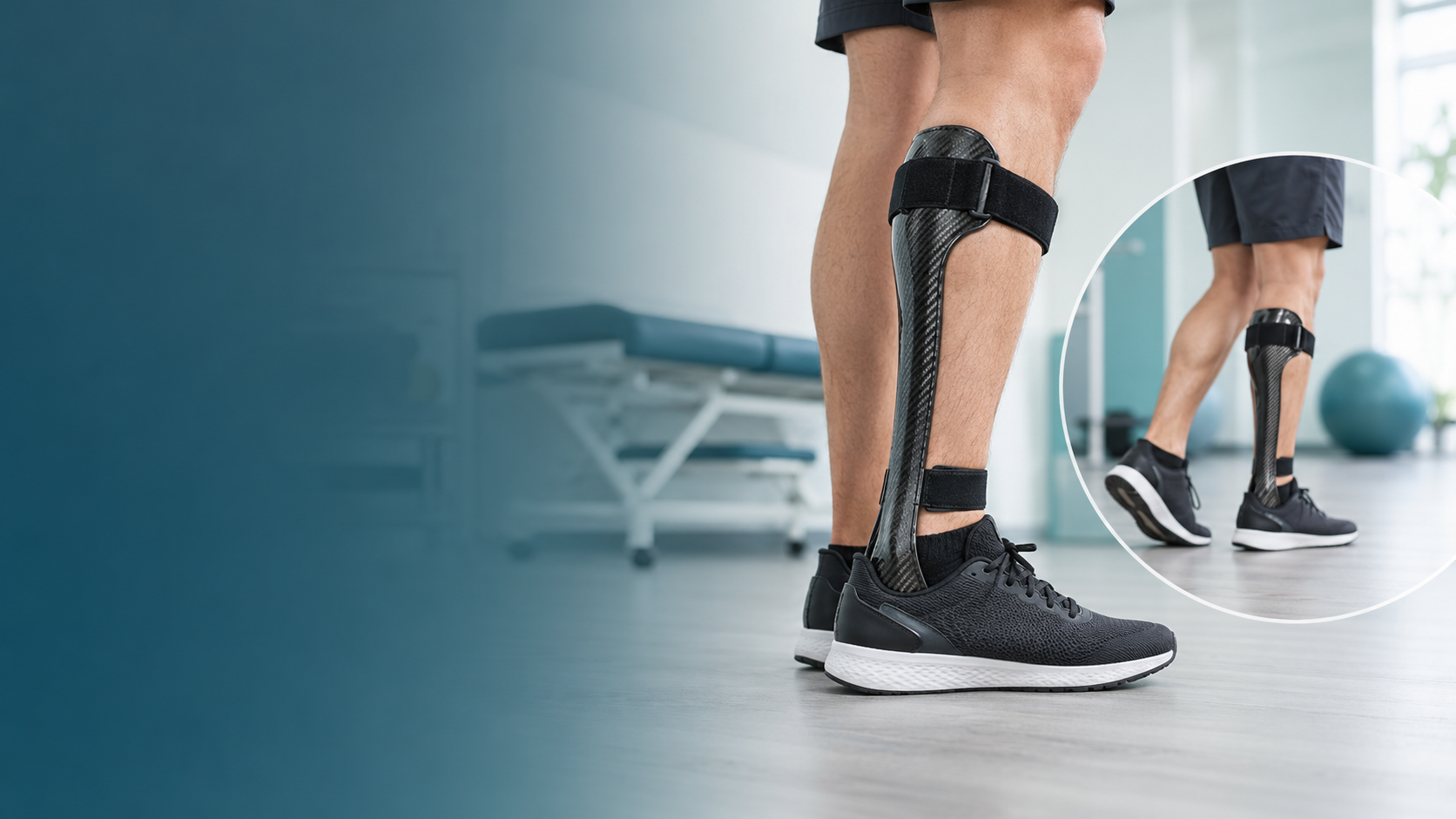
Understanding Carbon Fiber Ankle-Foot Orthoses (AFOs): Benefits, Indications and Clinical Applications
An ankle-foot orthosis, or AFO, supports the foot and ankle to improve alignment, stability and walking safety. Traditional thermoplastic AFOs remain highly valuable and adaptable, but advances in composite materials have expanded the options available to clinicians. Carbon fiber AFOs are lightweight devices designed to provide support while using the controlled flexibility of the material to assist movement.
The term “carbon fiber AFO” includes several designs. Some are prefabricated and selected by size, while others are custom manufactured from a patient model or digital scan. Their stiffness, strut position, footplate length and overall geometry can differ considerably. The material alone does not determine the clinical result: assessment, prescription, alignment, footwear and rehabilitation are equally important.
A carbon fiber AFO should be prescribed according to the person’s muscle strength, joint range, alignment, body weight, walking pattern, activity goals and ability to tolerate pressure—not simply because the material is modern or lightweight.
What Makes Carbon Fiber Different?
Carbon fibers are combined with a resin matrix to create a composite. When the fibers and layers are arranged appropriately, the finished orthosis can be thin, strong and relatively light. A dynamic design may deflect under load and then release part of the stored energy as the person progresses through the gait cycle.
This response is often described as energy storage and return. It does not replace muscle power, and it is not suitable for every condition. Instead, it can complement remaining muscle function, improve toe clearance and influence ankle motion when the design is correctly matched to the individual.
Potential Benefits
- Low weight: Composite construction can reduce bulk compared with some conventional designs.
- Slim profile: Many models fit more easily inside suitable footwear.
- Toe clearance: The orthosis can help hold the foot in a safer position during swing phase for selected people with foot drop.
- Dynamic response: Certain designs flex during loading and assist progression during stance.
- Consistent stiffness: A carefully engineered laminate can deliver a repeatable mechanical response.
- Durability: Carbon composites can provide high strength relative to their weight when manufactured and used correctly.
Common Clinical Indications
Depending on the design and assessment findings, a carbon fiber AFO may be considered for:
- Foot drop following stroke, peripheral nerve injury or other neurological conditions
- Weak ankle dorsiflexors with adequate passive ankle range
- Selected presentations of multiple sclerosis or incomplete spinal cord injury
- Charcot–Marie–Tooth disease and other peripheral neuropathies, when pressure and alignment can be managed safely
- Selected neuromuscular weakness where controlled dynamic assistance is appropriate
- People seeking a lower-profile device for community walking or work activities
Diagnosis alone is never enough to select an AFO. Two people with the same diagnosis may need very different stiffness, alignment or control because their strength, range of motion, balance and gait goals are different.
When Carbon Fiber May Not Be Appropriate
Carbon fiber AFOs are generally difficult to reshape after fabrication. A device may be unsuitable when major accommodation, frequent modification or close total-contact pressure distribution is required.
Extra caution or an alternative design may be needed with severe fixed deformity, significant ankle instability, uncontrolled spasticity, marked knee instability, rapidly changing limb shape, substantial edema, fragile skin, active wounds or major sensory loss. Some people require more control than a lightweight dynamic design can provide.
A rigid footplate, narrow edge or poorly matched strut can create excessive pressure. Anyone with diabetes, neuropathy or impaired sensation needs careful skin assessment, appropriate footwear and a clear monitoring plan.
Carbon Fiber and Thermoplastic AFOs
| Consideration | Carbon Fiber AFO | Thermoplastic AFO |
|---|---|---|
| Weight and profile | Often lightweight and thin | Varies with material and design |
| Dynamic response | Can provide efficient spring-like behavior | Can be flexible or rigid, depending on trimlines and material |
| Heat adjustment | Usually limited after manufacture | Often allows localized heat modification |
| Accommodation | May be less suitable for major shape changes | Often easier to pad, flare and modify |
| Design options | Prefabricated and custom composite systems | Wide range of custom designs and joint options |
Neither material is automatically superior. The best orthosis is the one that safely provides the required control, comfort and functional benefit for the individual.
The Importance of Stiffness and Alignment
An AFO changes forces at the ankle and can also influence the knee and hip. If it allows or restricts tibial progression, it may change the external knee moment during stance. For this reason, AFO stiffness, ankle angle, footplate design and footwear heel height should be considered as one system.
A device that is too flexible may not provide enough toe clearance or stance control. One that is too stiff may restrict forward progression, increase compensatory movement or create unwanted knee effects. Observation of walking, functional testing and patient feedback help the clinician tune the prescription.
Prefabricated or Custom Made?
Prefabricated carbon fiber AFOs
These are available in standard sizes and different strut configurations. They can be useful when the person’s anatomy and clinical needs match the available design. A trial can help assess comfort, clearance and gait response before final selection.
Custom carbon fiber AFOs
Custom fabrication allows the shape, stiffness, trimlines and pressure-relief areas to be planned around the individual. Casting or 3D scanning may be used to capture limb geometry. Custom manufacture is particularly valuable when standard sizes do not provide an appropriate fit or when more precise control is required.
Footwear Is Part of the Prescription
The shoe affects the way the AFO functions. It should provide adequate internal depth, secure fastening, a stable sole and sufficient width for the footplate. The heel height should match the alignment used during fitting. Changing to a shoe with a very different heel-to-toe profile can alter posture and the mechanical effect of the orthosis.
Bring the footwear you use most often to the assessment and fitting appointments. Do not cut, grind or permanently change a carbon fiber device yourself.
Fitting, Training and Follow-Up
At delivery, the clinician should examine pressure areas, suspension, shoe fit, standing alignment and walking performance. The user needs clear instructions for applying the AFO, increasing wear gradually and checking the skin. Rehabilitation may include strength, balance, gait training, stairs and practice on community surfaces.
- Inspect the skin after each wearing period, especially during the first weeks.
- Report persistent redness, blistering, pain, numbness or swelling.
- Stop using the AFO if it cracks, delaminates, develops sharp edges or changes shape.
- Attend review appointments to reassess fit, function and clinical goals.
Frequently Asked Questions
Will a carbon fiber AFO make walking normal?
It may improve selected gait problems, but outcomes depend on the underlying condition, strength, joint range, balance, device design, footwear and training. The realistic goal is safer and more efficient function—not a guaranteed “normal” gait.
Can carbon fiber AFOs be adjusted?
Straps, padding and some interfaces may be adjusted, but the composite shell usually cannot be heat-remolded like thermoplastic. Major fit or alignment problems require professional review and may require a different device.
Can I play sport with one?
Only after assessment. Everyday carbon AFOs are not automatically designed for running, jumping or contact sport. Activity-specific orthoses and structured training may be needed.
How long will it last?
Service life varies with design, body weight, activity, fit, care and changes in the person’s condition. Regular inspection is more meaningful than relying on one fixed replacement period.
Key Takeaways
- Carbon fiber AFOs can be lightweight, slim and dynamically responsive.
- The mechanical design matters as much as the material.
- Patient selection must consider strength, range, alignment, skin, sensation and goals.
- AFO stiffness, alignment and footwear work together to influence gait.
- Professional fitting, gradual wear, skin monitoring and follow-up are essential.
This article provides general education and does not replace an individual assessment by a qualified Prosthetist and Orthotist or rehabilitation professional.