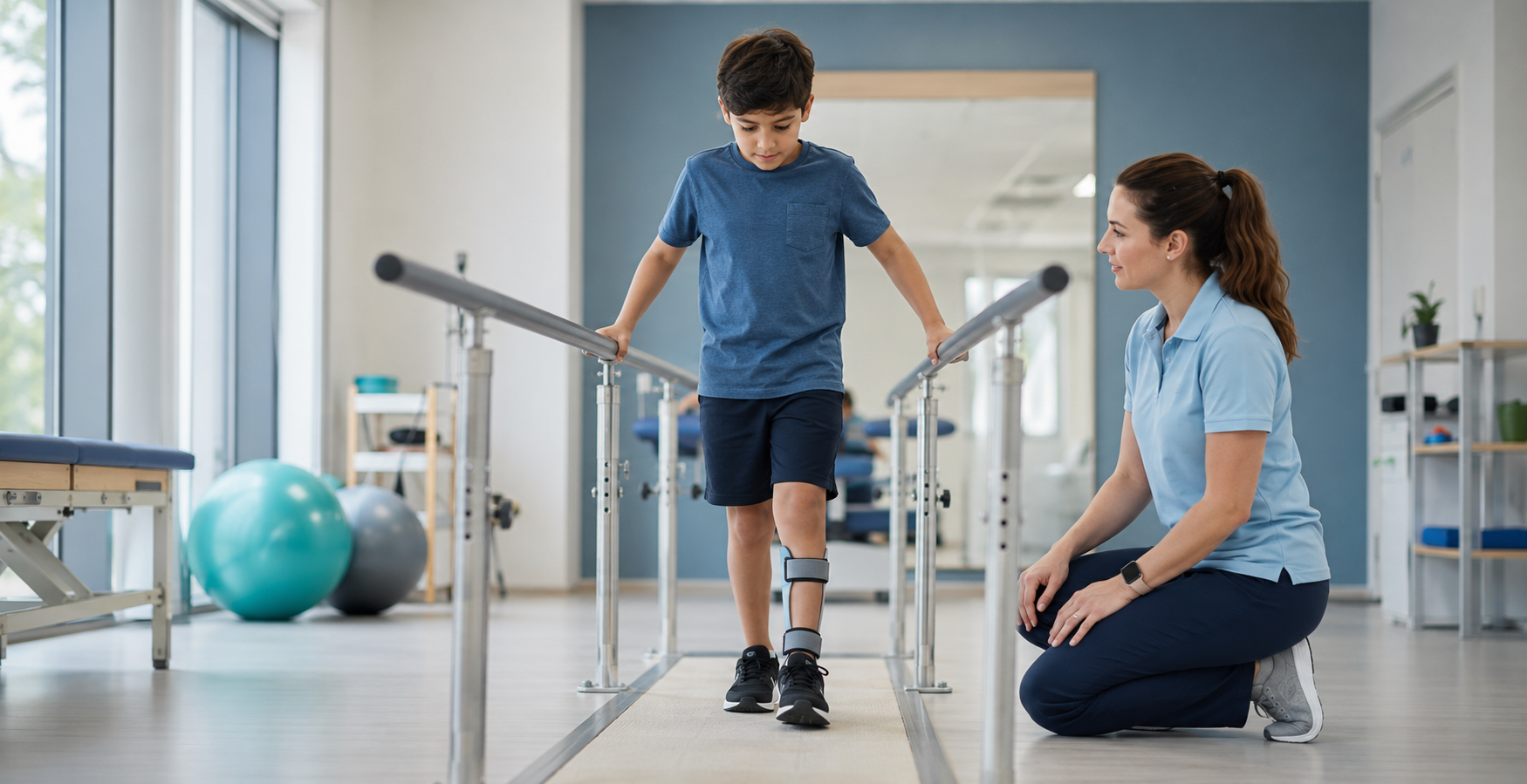
Cerebral Palsy and Orthotic Management: Selecting the Right AFO for Gait and Function
Cerebral palsy can affect muscle tone, selective motor control, strength, balance and the way a child uses the foot, ankle and knee during walking. An ankle-foot orthosis may improve stability, foot clearance or energy efficiency, but there is no single “cerebral palsy AFO.” The prescription must respond to the individual child’s gait, available range of motion, strength, goals and environment.
An AFO should be selected for the movement problem that needs to be controlled, assisted or permitted—not from the diagnosis alone.
Begin with a Complete Assessment
Orthotic planning begins before choosing a design. The team should observe the child barefoot and in footwear, when safe, and consider standing, transfers, walking speed, endurance and participation. Important findings include:
- Passive ankle range with the knee flexed and extended, including gastrocnemius tightness.
- Foot alignment, flexibility and whether a deformity is correctable.
- Hip, knee and ankle strength, tone and selective motor control.
- Knee position during stance, including flexion, hyperextension or instability.
- Foot clearance, initial contact, step length, cadence and compensations.
- Skin condition, sensation, previous orthotic experience and tolerance.
- The child’s priorities at home, school and in therapy.
Understanding Common Gait Presentations
Equinus and Toe Walking
Excessive plantarflexion can produce forefoot contact, reduce stability and interfere with swing-phase clearance. A design that limits plantarflexion may promote a more stable initial contact, but the required rigidity depends on the child’s control, range and knee response.
Jump Gait
Jump gait may combine equinus with excessive hip and knee flexion. Controlling plantarflexion can improve the floor-reaction pathway, but the entire lower limb must be assessed. An ankle correction alone does not automatically correct proximal flexion.
Crouch Gait
Crouch gait involves excessive knee flexion in stance and often increased energy demand. A ground-reaction AFO may help create an external knee-extension influence when adequate hip and knee range, strength and alignment are present. Fixed contracture, severe weakness or poor tolerance may limit the result.
Knee Hyperextension
When the tibia does not advance appropriately over the foot, the ground-reaction force may pass too far in front of the knee and contribute to hyperextension. AFO ankle angle, stiffness, heel height and footwear must be considered together rather than treating the AFO as an isolated device.
Common AFO Design Options
| Design | Possible clinical role | Important considerations |
|---|---|---|
| Solid AFO | Strong control of plantarflexion and mediolateral ankle motion. | May restrict useful ankle movement; alignment and footwear tuning strongly affect the knee. |
| Hinged AFO | Allows selected dorsiflexion while limiting plantarflexion. | Requires sufficient control and range; not ideal when unrestricted tibial progression worsens crouch. |
| Posterior leaf-spring AFO | Provides lighter swing-phase assistance for foot clearance. | Offers less stance control and is unsuitable when substantial mediolateral or knee influence is required. |
| Ground-reaction AFO | May support knee extension during stance in selected crouch presentations. | Needs careful anterior shell fit, correct ankle angle and appropriate footwear. |
| Flexible or supramalleolar design | Supports foot alignment while preserving more ankle movement. | Does not provide the same sagittal-plane control as a full AFO. |
The AFO–Footwear Combination
The device does not function independently from the shoe. Heel height, sole stiffness, rocker profile, toe-box depth and secure fastening change tibial progression and the resulting knee moment. The AFO should therefore be assessed inside the intended footwear during standing and walking. A change of shoe can change the apparent success of the prescription.
Growth, Comfort and Follow-Up
Children grow quickly, and changes in height, weight, activity, tone or treatment can alter the fit and mechanical demand. Families should receive clear instructions on wearing progression, socks, skin inspection, cleaning and warning signs. Follow-up should examine:
- Heel seating, strap position, edge clearance and focal pressure.
- Whether the child can apply and remove the orthosis safely.
- Walking quality and function in the child’s usual footwear.
- Whether the original goals remain relevant and measurable.
- Growth-related tightness, deformation, wear or structural damage.
Persistent redness, blistering, pain, increased falls, new knee problems, refusal to wear the device or a sudden change in walking should trigger reassessment. Families should not heat, cut or structurally alter an AFO at home.
Orthoses Work Within Rehabilitation
An AFO is one part of a broader plan that may include physiotherapy, strengthening, stretching, gait training, medical tone management, surgery and environmental support. The best result comes from shared goals among the child, family, rehabilitation team and orthotist. Success should be judged by meaningful function—safer walking, better endurance, easier participation or improved stability—not only by a more symmetrical appearance.
Conclusion
Orthotic management in cerebral palsy requires careful observation and ongoing adjustment. By matching design, stiffness, alignment and footwear to the child’s specific gait problem and goals, an AFO can support mobility without unnecessarily limiting useful movement.
Educational note: This article provides general professional education and does not replace an individual assessment, diagnosis or prescription by a qualified healthcare team.