Outcome Measures in Prosthetics and Orthotics: Measuring Function Beyond Device Fit
A prosthesis or orthosis can look technically correct during a fitting and still fail to achieve the outcome that matters to the person using it. Successful rehabilitation is not defined only by socket contact, alignment, trimlines or component selection. It must also be judged by safety, mobility, comfort, confidence, participation and progress toward meaningful goals.
Measure what the device is expected to change. Combine professional observation with the user’s experience and real-life priorities.
What Is an Outcome Measure?
An outcome measure is a structured method used to describe a person’s status or change over time. It may be a performance test, questionnaire, rating scale, activity record or goal-based review. Standardized measures improve consistency, but the result remains meaningful only when interpreted within the person’s diagnosis, environment, rehabilitation stage and objectives.
Why Measurement Matters
- Creates a baseline before intervention or major adjustment.
- Shows whether function changes after provision and training.
- Supports clinical reasoning when comparing device options.
- Identifies problems that a static fitting may not reveal.
- Improves communication within the multidisciplinary team.
- Provides evidence for follow-up, service quality and funding decisions.
- Keeps treatment focused on outcomes important to the patient.
Important Outcome Domains
| Domain | Clinical question | Possible approach |
|---|---|---|
| Body function | Has pain, range, strength, skin tolerance or balance changed? | Examination, pain scale, range and strength testing. |
| Activity | Can the person stand, transfer, walk, climb or use the upper limb more effectively? | Timed or task-based performance tests. |
| Participation | Can the person return to school, work, family and community roles? | Interview, participation questionnaire and goal review. |
| Device use | How long and in which environments is the device actually used? | Wear-time report, diary or activity monitoring. |
| Comfort and satisfaction | Is the device acceptable throughout the required wearing time? | Comfort rating, patient-reported outcome measure and structured feedback. |
| Safety | Are falls, near-falls, skin problems or unsafe compensations reduced? | Incident history, skin inspection and functional observation. |
Performance-Based Measures
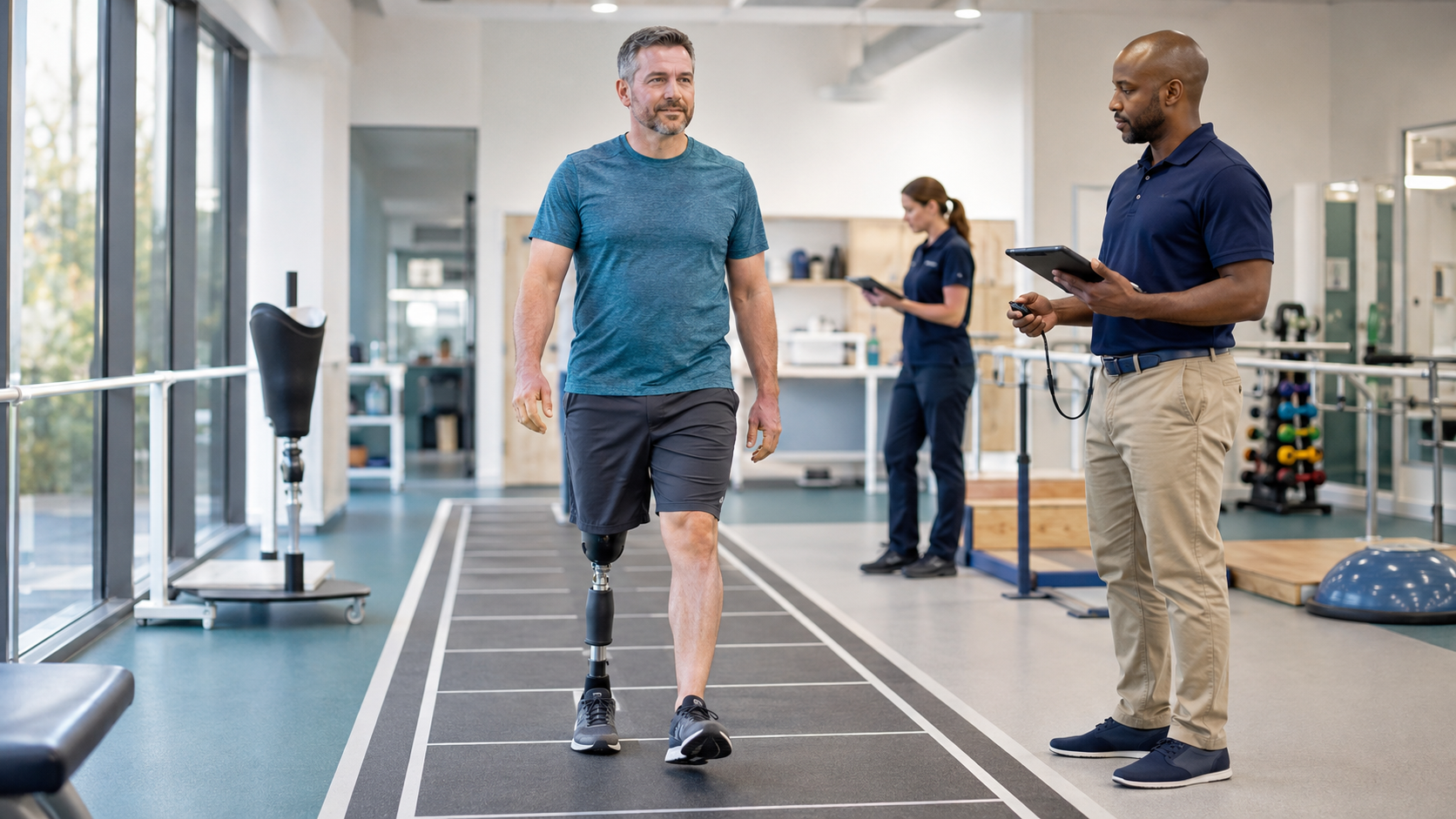
Performance tests show what a person can do under defined conditions. Depending on the clinical question, this may include walking speed, a timed mobility task, repeated sit-to-stand, step negotiation, balance testing, endurance or an upper-limb activity. A measure should be selected because it relates to the intended outcome—not simply because it is quick or familiar.
Testing conditions should be recorded. Footwear, walking aid, assistive device, surface, instructions and level of assistance can all affect the result. Repeating a test under different conditions without documentation can create misleading comparisons.
Patient-Reported Outcomes
Clinical observation cannot fully describe comfort, confidence, fatigue, appearance, ease of donning or participation. Patient-reported measures capture the user’s perspective. This is essential because two people with similar gait findings may experience very different benefits or burdens.
Simple questions can add value: What activity became easier? What remains difficult? Where is the device not being used? What causes the person to remove it? A score should support this conversation, not replace it.
Goal-Based Measurement
Goals should be specific and connected to daily life. “Improve walking” is too broad. A more useful goal might be walking safely from home to a nearby shop using the prescribed aid, or wearing an AFO throughout the school morning without skin problems. Goal attainment can then be reviewed using observable criteria and an agreed timeframe.
Before-and-After Comparison
- Define the main problem and the intended device effect.
- Record a baseline using appropriate measures.
- Document the device, alignment, footwear and assistance used.
- Allow suitable accommodation and rehabilitation training.
- Repeat relevant measures under comparable conditions.
- Combine numerical change with patient feedback and clinical interpretation.
- Decide whether to continue, adjust, retrain or reconsider the intervention.
Examples in Prosthetic Rehabilitation
For a new lower-limb prosthesis user, outcomes may include safe transfers, standing balance, walking distance, gait speed, energy demand, falls confidence, socket comfort and community participation. A more advanced component may improve one area but introduce weight, charging, maintenance or learning demands. Measurement helps determine whether the complete system provides meaningful benefit.
Examples in Orthotic Rehabilitation
For an AFO user, clinicians may evaluate foot clearance, ankle and knee behaviour, balance, walking speed, fatigue, skin tolerance, footwear compatibility and real-world wear. In pediatric care, participation in play and school, ease of application, family priorities and growth-related follow-up are also important. An improvement in one gait feature should not be accepted automatically if it creates pain, instability or reduced participation elsewhere.
Common Measurement Mistakes
- Testing only after intervention, with no baseline for comparison.
- Using too many measures without a clear clinical question.
- Changing footwear, aids or instructions between assessments.
- Interpreting a small score change without considering measurement error.
- Ignoring the patient’s priorities because a laboratory result improved.
- Measuring capacity in the clinic but never asking about performance at home or work.
No single test proves that a device is successful. Diagnosis, safety, adaptation time, environment and the person’s goals must be considered together.
A Practical Minimum Dataset
Services do not need an extensive research laboratory to begin measuring outcomes. A practical record can include the patient’s main goal, pain or comfort rating, a relevant timed functional task, device wear, skin status, falls or near-falls, and a short participation review. Consistent use of a small, relevant set is often more valuable than irregular use of many tools.
Conclusion
Outcome measurement moves prosthetic and orthotic care beyond “device delivered” toward “meaningful function achieved.” The strongest evaluation combines performance, patient experience, safety and participation. This supports better clinical decisions, clearer teamwork and rehabilitation that remains accountable to the person’s real life.
Professional references: World Health Organization, Rehabilitation 2030; World Health Organization and International Society for Prosthetics and Orthotics, Standards for Prosthetics and Orthotics; International Classification of Functioning, Disability and Health principles.