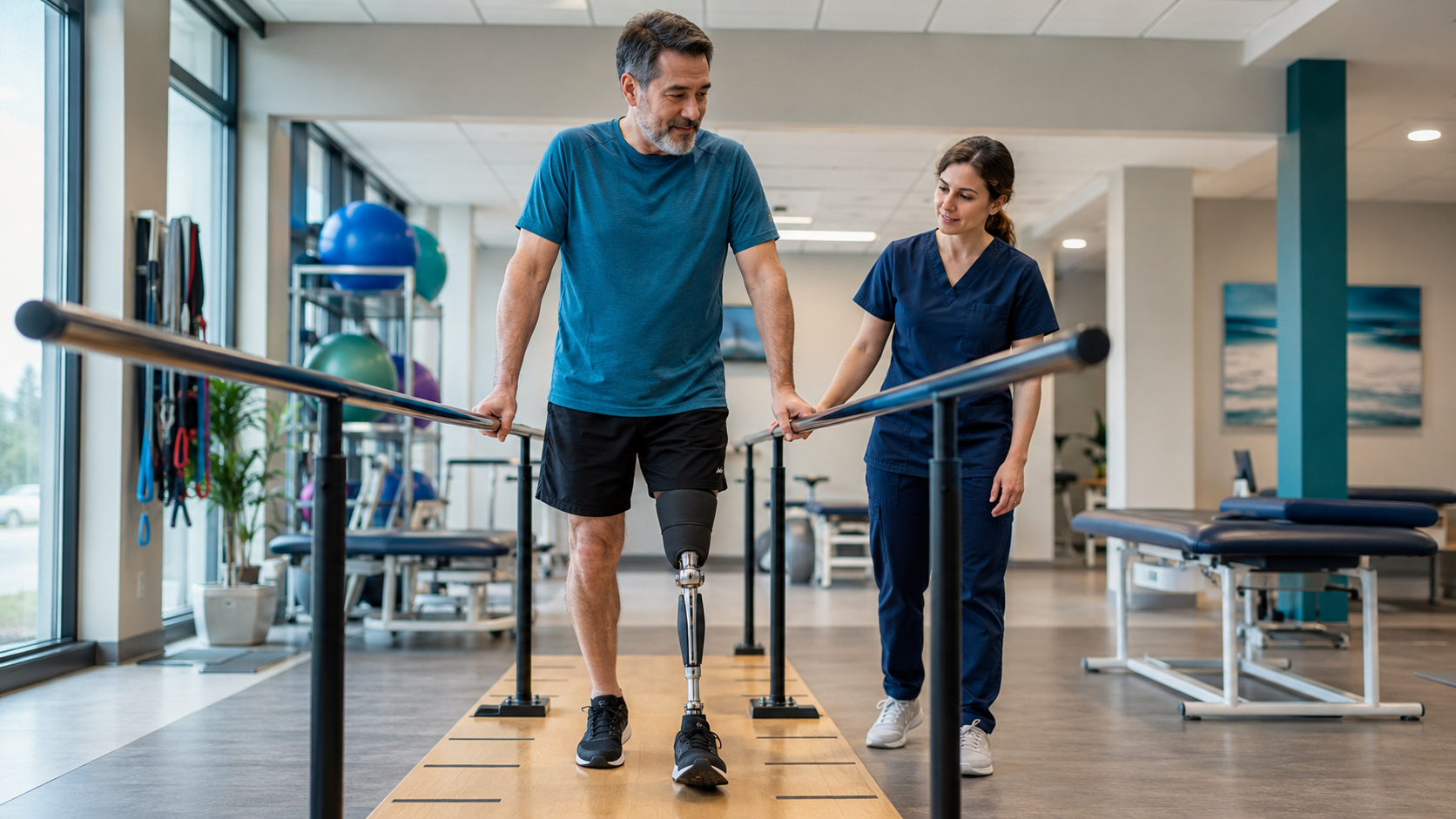
Preventing Falls in Lower-Limb Prosthesis Users
Falls and near-falls can occur during early prosthetic training or after years of successful use. They may cause injury, damage confidence and lead people to restrict activity. Fall prevention is therefore not one exercise or one component: it is a continuous process linking medical health, prosthetic fit, alignment, physical capacity, environment, training and behaviour.
A near-fall is valuable clinical information. Understanding when, where and why balance was lost can reveal a correctable risk before an injury occurs.
Why Fall Risk May Increase
Limb loss changes the base of support, sensory feedback and the strategies available to recover balance. Prosthetic users may also have pain, weakness, reduced vision, vascular disease, neuropathy or problems in the opposite limb. Uneven ground, fatigue and divided attention can challenge even a well-fitted system.
Common Risk Factors
| Area | Examples | Possible response |
|---|---|---|
| Medical | Dizziness, medication effects, poor vision, neuropathy, pain or reduced cardiovascular capacity. | Medical review and coordinated management. |
| Physical | Weakness, limited joint range, poor balance, fatigue or slow protective reactions. | Targeted rehabilitation and graded activity. |
| Prosthetic | Socket looseness, pain, poor suspension, alignment change, worn components or unsuitable footwear. | Prosthetic assessment, adjustment or repair. |
| Environmental | Loose rugs, poor lighting, wet floors, stairs, clutter, uneven ground or unsuitable handrails. | Environmental modification and task practice. |
| Behavioural | Rushing, carrying too much, multitasking, not using the prescribed aid or walking while fatigued. | Education, pacing and safer routines. |
Socket Fit and Suspension
Residual-limb volume can change through the day and over longer periods. Excessive movement inside the socket may delay control, increase rotation or reduce trust in the limb. Pain can cause sudden unloading and compensatory steps. Users should understand the prescribed volume-management method and seek review when fit remains loose, painful or unstable.
Alignment, Components and Footwear
Alignment affects stability during standing, loading and swing. A prosthetic knee, foot or ankle must match the person’s functional capacity and environment, then be set and trained appropriately. Footwear changes heel height, sole grip and effective alignment. Worn, loose or very soft footwear can undermine a previously stable prosthesis.
Alignment, knee settings and structural repairs require qualified professional assessment. Unapproved changes may create instability or mechanical failure.
Strength, Range and Endurance
Hip and trunk strength support control of a lower-limb prosthesis. Limited hip extension, knee flexion contracture or weakness may increase compensations and reduce recovery options. Endurance also matters: gait that is safe at the start of an activity may become less controlled with fatigue. Training should therefore include strength, flexibility and graded functional endurance.
Balance and Reactive Control
Balance training should progress safely from stable supported tasks toward weight transfer, reaching, turns, changing speed, obstacles and uneven surfaces. Reactive strategies—how to respond when balance is disturbed—should be practiced only under suitable professional supervision and with appropriate safety measures.
Gait Training
- Practice symmetrical and controlled weight transfer where achievable.
- Develop reliable foot clearance and step placement.
- Train starts, stops, turns and changes in direction.
- Practice ramps, curbs, stairs and variable surfaces progressively.
- Use the prescribed walking aid correctly rather than abandoning it early.
- Include dual-task and community situations only after foundational safety is established.
Home and Community Safety
Clear walking routes, secure rugs, adequate lighting and well-positioned handrails reduce avoidable hazards. Bathrooms and entrances deserve particular attention. Outdoors, users should scan ahead for level changes, loose surfaces, wet areas and obstacles. A phone, mobility aid and backup mobility plan may be important for longer community activities.
Falls Confidence
Fear of falling can be protective when it encourages caution, but excessive fear may reduce movement, strength and participation—potentially increasing future risk. Rehabilitation should use achievable progression, education and honest feedback. Confidence should be built on demonstrated skill, not pressure to appear independent.
What to Do After a Fall
- Check for pain, head injury, bleeding or inability to move safely.
- Seek urgent medical help when injury is suspected; do not rush to stand.
- Inspect the prosthesis for cracks, loose hardware, unusual movement or damage.
- Record what happened: location, surface, direction, activity and symptoms.
- Arrange clinical review after unexplained, repeated or injurious falls.
- Review medical, prosthetic, therapy and environmental contributors together.
When Prompt Review Is Needed
- A sudden increase in falls or near-falls.
- New dizziness, weakness, confusion, vision change or loss of consciousness.
- New socket pain, skin injury, looseness or difficulty controlling the prosthesis.
- Clicking, cracking, loosened hardware or suspected structural damage.
- A fall involving head impact or significant injury.
A Practical Prevention Plan
Each person should know their main risk factors, correct prosthesis and footwear routine, prescribed mobility aid, safe exercise plan, environmental precautions and contact pathway for review. Regular reassessment is especially important after illness, surgery, weight change, a new prosthesis, component change or a meaningful change in activity.
Conclusion
Falls prevention is most effective when it is proactive and individualized. A stable prosthetic system, sufficient physical capacity, progressive training, safe surroundings and confident decision-making work together. Asking about near-falls—and acting on the answer—helps rehabilitation teams protect mobility without unnecessarily limiting independence.
Professional references: World Health Organization rehabilitation principles; WHO and ISPO, Standards for Prosthetics and Orthotics. This article provides general education and does not replace individualized medical, prosthetic or therapy assessment.