Introduction
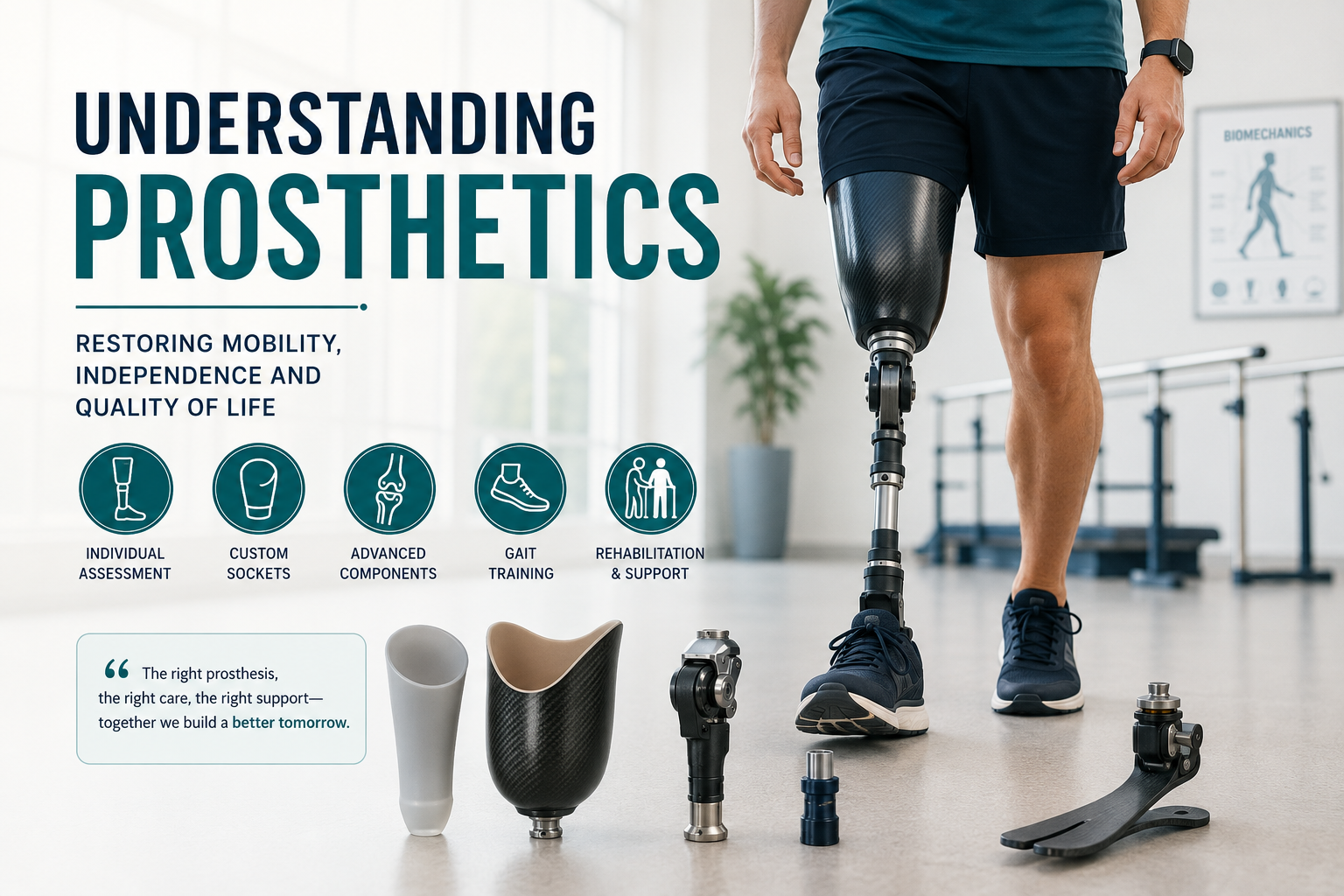
Limb loss is a significant life event, but it does not define a person's future. Modern prosthetic technology, combined with rehabilitation and professional clinical care, can help individuals regain mobility, independence, confidence and participation in daily life.
Prosthetics brings together healthcare, biomechanics, engineering, material science and rehabilitation. The goal is not simply to replace a missing body part, but to create a safe and functional solution that supports the person's lifestyle, environment and individual goals.
What Is a Prosthesis?
A prosthesis is an artificial device designed to replace all or part of a missing limb. A person may require a prosthesis after an amputation or because of a congenital limb difference.
Depending on the level of limb absence and the person's goals, a prosthesis may help with walking, standing, balance, grasping, carrying objects, personal care, work, recreation and community participation.
What Is Prosthetics?
Prosthetics is the healthcare profession and clinical field concerned with the assessment, prescription, design, manufacture, fitting and follow-up of artificial limbs.
A prosthetist works with patients and the rehabilitation team to identify functional needs and develop an appropriate prosthetic treatment plan.
Goals of Prosthetic Rehabilitation
Prosthetic rehabilitation focuses on more than supplying a device. Its goals may include:
- Restoring functional mobility.
- Improving balance and stability.
- Supporting independence in daily activities.
- Reducing unnecessary physical effort.
- Protecting the remaining joints and opposite limb.
- Improving confidence and body image.
- Supporting participation in work, education and recreation.
- Improving overall quality of life.
Who May Benefit From a Prosthesis?
Prosthetic treatment may be considered for individuals with limb loss related to:
- Traumatic injury.
- Diabetes.
- Peripheral vascular disease.
- Severe infection.
- Cancer.
- Congenital limb difference.
- Burns or complex tissue damage.
- Military or conflict-related injuries.
Not every individual with limb loss requires or benefits from the same type of prosthesis. Medical health, strength, balance, healing, motivation, lifestyle and rehabilitation potential must all be considered.
Types of Lower-Limb Prostheses
| Prosthesis Type | Level | Main Function |
|---|---|---|
| Partial-Foot Prosthesis | Part of the foot is absent | Supports balance, foot shape, pressure distribution and progression. |
| Syme Prosthesis | Ankle disarticulation | Provides support and restores limb length after ankle-level amputation. |
| Transtibial Prosthesis | Below-knee amputation | Replaces the missing lower leg and foot while preserving the knee. |
| Knee Disarticulation Prosthesis | Through-knee amputation | Replaces the lower leg and includes a prosthetic knee and foot. |
| Transfemoral Prosthesis | Above-knee amputation | Includes a socket, prosthetic knee, connecting components and foot. |
| Hip Disarticulation Prosthesis | Entire lower limb absent through the hip | Replaces the hip, knee, lower leg and foot using a specialized design. |
Types of Upper-Limb Prostheses
Upper-limb prostheses may support appearance, positioning, grasp, object handling and specific functional activities.
- Partial-hand prosthesis.
- Wrist-disarticulation prosthesis.
- Transradial prosthesis.
- Elbow-disarticulation prosthesis.
- Transhumeral prosthesis.
- Shoulder-disarticulation prosthesis.
- Forequarter prosthesis.
Upper-limb systems may be cosmetic, body-powered, externally powered, activity-specific or hybrid designs.
Main Components of a Lower-Limb Prosthesis
Socket
The socket is the custom-made interface that fits around the residual limb. It transfers forces and connects the patient to the prosthesis.
Liner
A liner may protect the skin, improve comfort, distribute pressure and contribute to prosthetic suspension.
Suspension System
Suspension keeps the prosthesis securely attached during standing, walking and daily activities.
Prosthetic Knee
For above-knee users, the prosthetic knee supports stability, controlled bending and safe progression during walking.
Prosthetic Foot
The prosthetic foot provides support, shock absorption, stability and forward progression.
Structural Components
Adapters, tubes and connectors join the components and allow alignment adjustments.
The Prosthetic Socket
The socket is often considered the most important part of the prosthesis because it directly surrounds the residual limb.
A successful socket should:
- Distribute pressure appropriately.
- Provide stability and control.
- Reduce unwanted movement inside the socket.
- Protect sensitive areas.
- Allow comfortable daily use.
- Support the intended functional activity.
Even advanced prosthetic components cannot perform effectively if the socket is uncomfortable or unstable.
Prosthetic Liners
Prosthetic liners are worn over the residual limb before the socket is applied. They may improve comfort and help protect the skin.
Common liner materials include:
- Silicone.
- Polyurethane.
- Thermoplastic elastomer.
Liner selection depends on skin condition, residual-limb shape, activity level, suspension method and clinical requirements.
Prosthetic Suspension Systems
Suspension describes how the prosthesis remains attached to the residual limb. Good suspension improves control and reduces unwanted movement.
Common suspension options include:
- Pin-lock suspension.
- Suction suspension.
- Elevated-vacuum suspension.
- Seal-in suspension.
- Anatomical suspension.
- Belts, straps or sleeves.
The choice of suspension should consider hand function, skin condition, residual-limb length, daily activities and the patient's ability to apply and remove the prosthesis independently.
Mechanical and Microprocessor Prosthetic Knees
Mechanical knees
Mechanical knees use physical mechanisms to control stability and swing. They may be simple, durable and appropriate for many users.
Microprocessor knees
Microprocessor knees use sensors and computer-controlled resistance to respond to changes in walking speed, terrain and movement.
Depending on the patient and the selected system, possible benefits may include:
- Improved stance stability.
- Better adaptation to changing walking speeds.
- Improved control on slopes and stairs.
- Reduced risk of some types of falls.
- Greater confidence during community mobility.
These systems still require appropriate patient selection, training, maintenance and regular follow-up.
Types of Prosthetic Feet
Prosthetic feet are selected according to the patient's activity level, stability needs, body weight, environment and functional goals.
- SACH feet.
- Single-axis feet.
- Multi-axial feet.
- Dynamic-response feet.
- Carbon-fiber energy-storing feet.
- Microprocessor-controlled feet and ankles.
- Activity-specific sports feet.
Prosthetic Assessment
Before prescribing a prosthesis, the prosthetist completes a detailed evaluation. This may include:
- Amputation level.
- Residual-limb shape and length.
- Skin condition and wound healing.
- Muscle strength.
- Joint range of motion.
- Balance and coordination.
- Current mobility.
- Medical history.
- Pain and sensation.
- Occupation and daily activities.
- Home and community environment.
- Personal goals and expectations.
Prosthetic prescription should be individualized. Two patients with the same amputation level may require very different prosthetic designs.
The Prosthetic Fitting Process
1. Initial Assessment
The clinician evaluates the patient, residual limb, mobility, medical condition and functional goals.
2. Casting or 3D Scanning
Measurements and an accurate model of the residual limb are obtained.
3. Test Socket
A temporary socket may be used to assess fit, pressure distribution, comfort and alignment.
4. Component Selection
Appropriate suspension, joints, feet and structural components are selected.
5. Dynamic Alignment
The prosthesis is adjusted while the patient stands and walks.
6. Delivery and Training
The patient learns how to apply, remove, use, clean and inspect the prosthesis.
Why Dynamic Alignment Matters
Prosthetic alignment influences comfort, stability, gait pattern, pressure distribution and energy use.
During dynamic alignment, the prosthetist observes the patient while standing and walking and makes careful adjustments to improve function. Alignment should never be based only on the appearance of the prosthesis while the patient is sitting.
The Importance of Gait Training
Receiving a prosthesis is only one stage of rehabilitation. Patients often require structured gait training with a physiotherapist and prosthetist.
Training may include:
- Applying and removing the prosthesis.
- Standing balance.
- Weight shifting.
- Walking between parallel bars.
- Walking with or without an assistive device.
- Turning and changing direction.
- Managing ramps and slopes.
- Negotiating stairs.
- Walking on uneven surfaces.
- Fall prevention and recovery strategies.
Daily Prosthetic and Residual-Limb Care
Good hygiene and routine inspection help prevent skin problems and extend the useful life of the prosthesis.
Patients should:
- Wash and dry the residual limb daily.
- Inspect the skin for redness, blisters or wounds.
- Clean liners according to professional instructions.
- Use clean prosthetic socks when prescribed.
- Check straps, sleeves and suspension components.
- Report unusual noise, movement or instability.
- Avoid unauthorized adjustments.
- Attend regular follow-up appointments.
Common Prosthetic Problems
Prosthetic users may occasionally experience:
- Skin redness or pressure areas.
- Changes in residual-limb volume.
- Socket looseness.
- Excessive sweating.
- Pain or discomfort.
- Suspension problems.
- Alignment-related instability.
- Component wear or mechanical noise.
Persistent pain, wounds or instability should be reviewed promptly by the prosthetic and medical team.
Common Misconceptions About Prosthetics
Every prosthesis is the same
This is incorrect. Every prosthesis should be prescribed according to the patient's anatomy, health, function, environment and goals.
The most expensive prosthesis is always the best
Advanced technology can be helpful, but it must be clinically appropriate and manageable for the patient.
Rehabilitation ends after prosthetic delivery
Prosthetic rehabilitation continues through training, adjustments, education, maintenance and long-term follow-up.
A prosthesis will feel exactly like the natural limb
A prosthesis can provide important function, but it cannot fully reproduce natural sensation and biological movement.
The Future of Prosthetics
Prosthetic technology continues to develop rapidly. Current and emerging areas include:
- Microprocessor-controlled knees and ankles.
- Powered prosthetic joints.
- Advanced carbon-fiber materials.
- 3D scanning and digital design.
- 3D-printed components.
- Smart sensors and activity monitoring.
- Osseointegration.
- Myoelectric upper-limb control.
- Pattern-recognition systems.
- Artificial-intelligence-assisted gait analysis.
Technology is valuable, but skilled assessment, socket comfort, rehabilitation and patient education remain essential.
The Multidisciplinary Rehabilitation Team
Successful prosthetic rehabilitation may involve:
- Surgeons and physicians.
- Prosthetists and orthotists.
- Physiotherapists.
- Occupational therapists.
- Nurses and wound-care specialists.
- Psychologists and counsellors.
- Social workers.
- Peer-support representatives.
Coordinated teamwork helps address the patient's physical, functional, emotional and social needs.
Conclusion
Modern prosthetics combines clinical knowledge, biomechanics, engineering, rehabilitation and individualized patient care.
A successful prosthesis should be comfortable, safe, functional and appropriate for the person's lifestyle and goals. Advanced components may improve performance, but socket fit, alignment, training, education and ongoing follow-up remain central to successful outcomes.
With the right prosthetic intervention and rehabilitation plan, many individuals with limb loss can return to active, independent and meaningful lives.