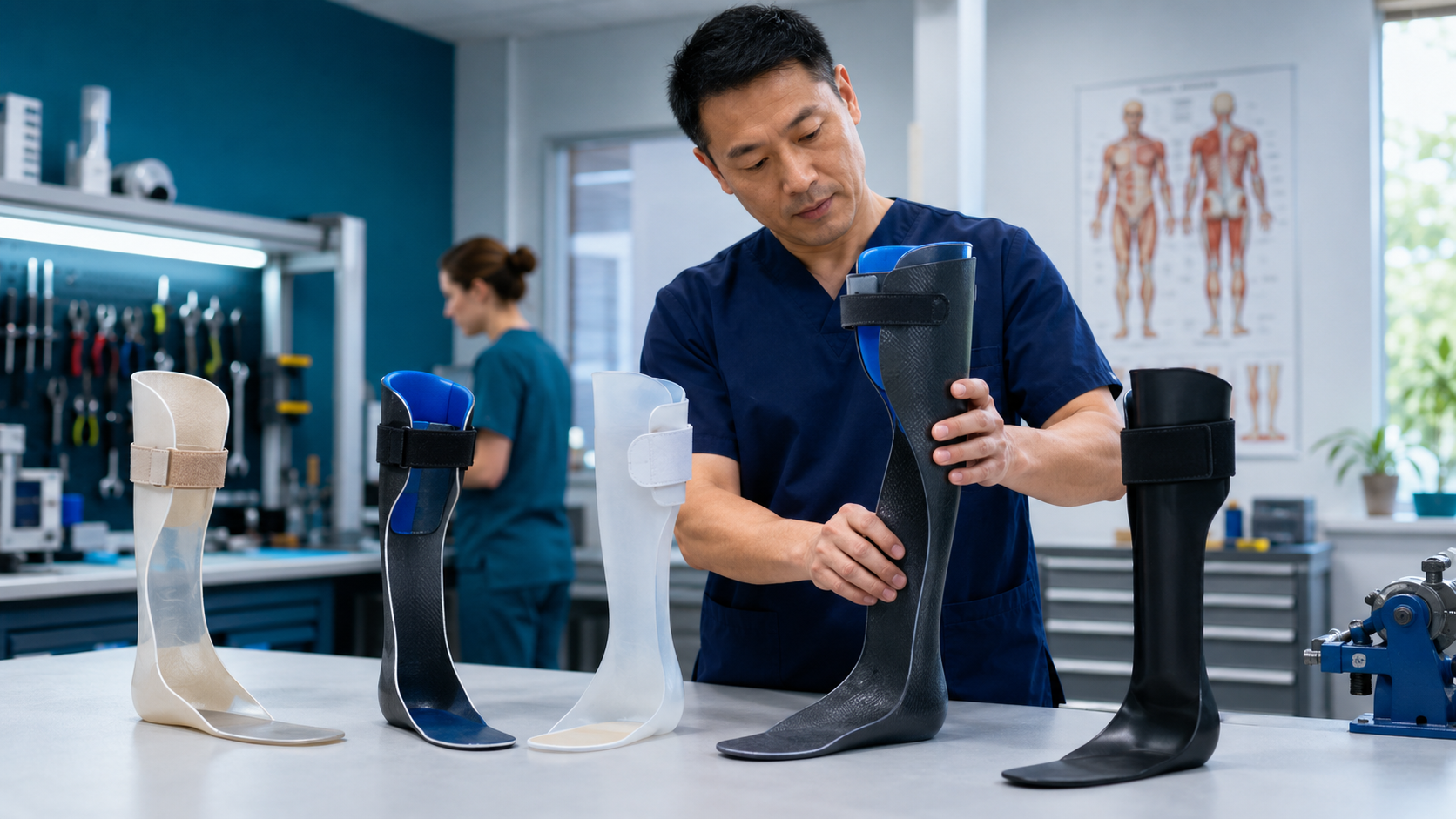
AFO Trimlines: Balancing Strength, Flexibility and Biomechanical Control
Trimlines are not simply the final outline that makes an AFO look neat. Their position changes how the plastic resists movement, contains the foot and ankle, distributes force and survives repeated loading. A few millimetres can affect the behaviour of the finished orthosis.
Trim according to the prescription and biomechanical goal. Cosmetic reduction should never remove the structure required for safe control.
Trimlines as Part of the Prescription
An AFO works through its material, thickness, shape, alignment, footwear and trimlines together. The same polypropylene sheet can behave very differently when the ankle section is narrow and flexible versus broad and extended anteriorly. The workshop must understand whether the goal is dorsiflexion assistance, plantarflexion resistance, coronal control, immobilization or influence on the knee.
Behind or in Front of the Malleoli
Posterior trimlines behind the malleoli generally permit more ankle movement and are associated with flexible posterior-leaf-spring concepts. Moving trimlines anteriorly increases containment and resistance, supporting designs that require greater ankle control. Exact behaviour also depends on the posterior section, material, thickness and geometry.
Posterior Section and Flexibility
A narrow posterior strut usually allows more deformation, while a broader section increases stiffness. Sharp internal corners create stress concentration and increase the risk of cracking. Smooth transitions and appropriate radii are essential where the calf section narrows toward the ankle.
Coronal-Plane Control
Medial and lateral trimlines help control inversion, eversion and foot position. Cutting too low around the ankle or foot may reduce the lever arm needed to contain deformity. High control surfaces must still avoid direct pressure on malleoli, navicular, fibular head and other sensitive anatomy.
Footplate Trimlines
- A full-length footplate may influence toe extension, forefoot position and load distribution.
- A sulcus-length design may allow more toe movement but must finish smoothly.
- A short footplate changes the available lever arm and may be inappropriate when forefoot control is required.
- Medial and lateral borders must reflect the required containment and shoe space.
- The distal edge should not create a step, curl or focal pressure inside the footwear.
Proximal Trimline
The proximal border should provide sufficient leverage without restricting knee flexion or pressing into the fibular head, tibial tubercle or hamstring area. The posterior calf contour and strap location should help distribute load rather than concentrate it at one edge.
Material and Thickness Interaction
Trimlines cannot be chosen independently of material properties. PPH, PPC and other thermoplastics differ in rigidity, toughness and forming behaviour. Increasing thickness or reinforcing a section changes stiffness. A trimline copied from another device may not perform the same way when material, patient weight, activity or alignment differs.
Heat Forming and Edge Finishing
Heat modification can locally change shape and sometimes stiffness. Overheating may thin, stretch or weaken the material. Final edges should be smoothly cut, sanded and polished without deep tool marks. Padding should not be used to hide an inappropriate structural edge or poor alignment.
Common Trimline Errors
- Trimming aggressively for appearance before the functional fitting.
- Removing containment needed for varus or valgus control.
- Creating sharp corners at the ankle transition.
- Leaving an edge directly over a bony prominence.
- Using unequal medial and lateral borders without clinical intention.
- Reducing a footplate without considering shoe fit and forefoot control.
- Assuming a thick material will compensate for an unsuitable geometry.
When possible, retain conservative trimlines through the initial fitting. Material can be removed after control and comfort are confirmed; restoring an over-trimmed lever arm is far more difficult.
Functional Fitting Check
- Confirm the device matches the prescription and side.
- Inspect malleolar, navicular, fibular-head and edge clearances.
- Check the intended ankle resistance manually and during standing.
- Observe coronal alignment, foot containment and knee response.
- Evaluate gait with the intended footwear.
- Inspect skin after an appropriate trial.
- Only then complete final cosmetic trimming where safe.
Conclusion
Effective AFO trimlines balance control, flexibility, comfort, durability and footwear compatibility. They should express the clinical prescription in the finished material. Thoughtful, conservative trimming protects both biomechanical function and the time invested by the patient and team.