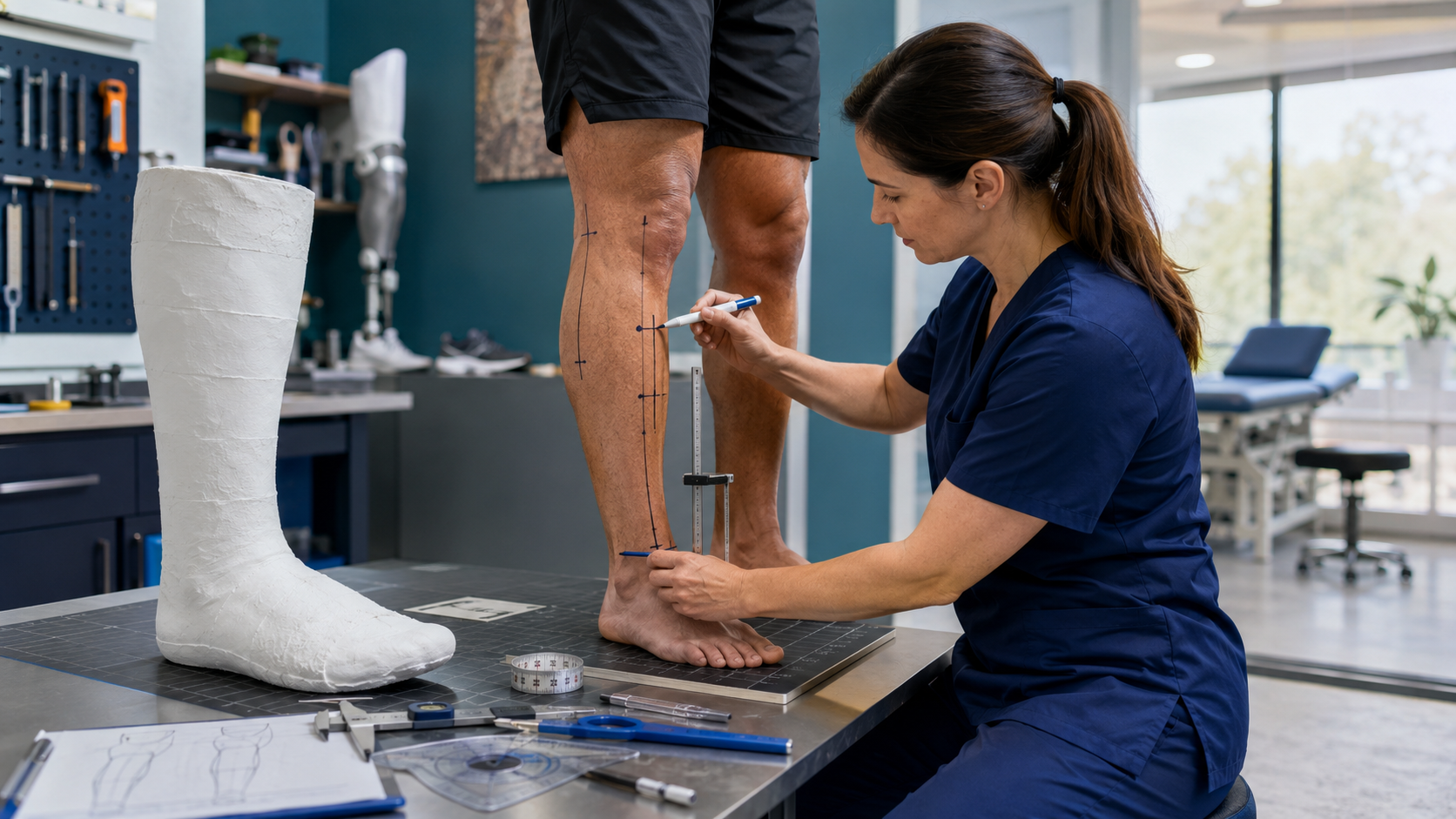
Casting and Measurement Errors: How Small Inaccuracies Affect the Final Orthosis
The quality of an orthosis begins before heating plastic, rectifying a model or trimming the finished device. If anatomical landmarks, alignment or measurements are inaccurate at the beginning, every later workshop stage may reproduce—or magnify—the error.
A neat finished orthosis cannot fully compensate for an inaccurate clinical impression. Check the input before investing time and materials in fabrication.
Why Small Errors Become Large Problems
An incorrect ankle angle can alter knee behaviour. A displaced malleolar mark can create pressure or an inappropriate trimline. A circumference taken obliquely can produce excess volume. These problems may appear only during fitting, when correction becomes more difficult and rework delays the patient’s rehabilitation.
Common Landmark Errors
- Marking the malleoli inaccurately or allowing marks to move during casting.
- Missing the fibular head, navicular, base of the fifth metatarsal or other pressure-sensitive areas.
- Using broad marks that do not show the exact anatomical centre.
- Failing to identify scars, wounds, bony prominences or sensitive skin.
- Transferring marks incompletely to the negative or positive model.
Patient Positioning and Alignment
The foot, ankle, knee and hip must be positioned according to the prescription and the person’s available range. Forcing a fixed deformity toward an unrealistic position can create pressure and loss of tolerance. Allowing an easily correctable position to collapse during casting can produce inadequate control.
The clinician should know whether the impression represents non-weight-bearing, partial weight-bearing or functional weight-bearing alignment. The workshop cannot safely guess what was intended.
Problems During the Cast
- Uneven bandage tension changes volume and shape.
- Wrinkles create false contours and pressure areas.
- Movement before the material sets distorts alignment.
- Poor molding misses the required control surfaces.
- Excessive manual pressure creates an unintended correction.
- Cutting and removal can damage the impression or lose alignment.
Measurement Errors
Measurements should be taken at clearly defined levels and recorded with units, side and position. Circumferences must be perpendicular to the limb axis unless a different method is specified. Lengths should use reproducible anatomical references. Shoe size alone is not an adequate substitute for foot length, width, depth and intended footwear information.
Communication Between Clinic and Worklab
A cast without a clear prescription is incomplete information. The work order should state diagnosis, device design, ankle position, joints or stops, material and thickness where prescribed, reinforcement, padding, reliefs, footwear considerations, activity needs and delivery priority. Photographs or sketches can help when they are appropriately consented and securely handled.
Pre-Modification Quality Check
- Patient identifier, side and device type match the work order.
- The impression is complete and structurally usable.
- Landmarks and pressure-sensitive areas are visible.
- Recorded measurements are plausible when checked against the model.
- Alignment and corrective position are clinically clear.
- Any uncertainty is resolved with the responsible clinician.
When to Stop and Repeat
Repeating a cast may feel like lost time, but fabricating from unreliable information can waste more material, staff time and appointments. Repeat or clarify when the cast is collapsed, incomplete, severely distorted, inconsistent with measurements or unable to represent the prescribed position safely.
Learning from Fitting Problems
When an orthosis requires major adjustment, the team should identify where the problem began. Was it assessment, casting, rectification, forming, trimming, assembly or fitting? A constructive review prevents the same error from becoming routine. The aim is not blame; it is a stronger clinical and workshop process.
Conclusion
Accurate casting and measurement reduce pressure problems, improve alignment, limit rework and protect delivery schedules. Precision at the first stage is one of the most effective quality-control tools available to a P&O service.