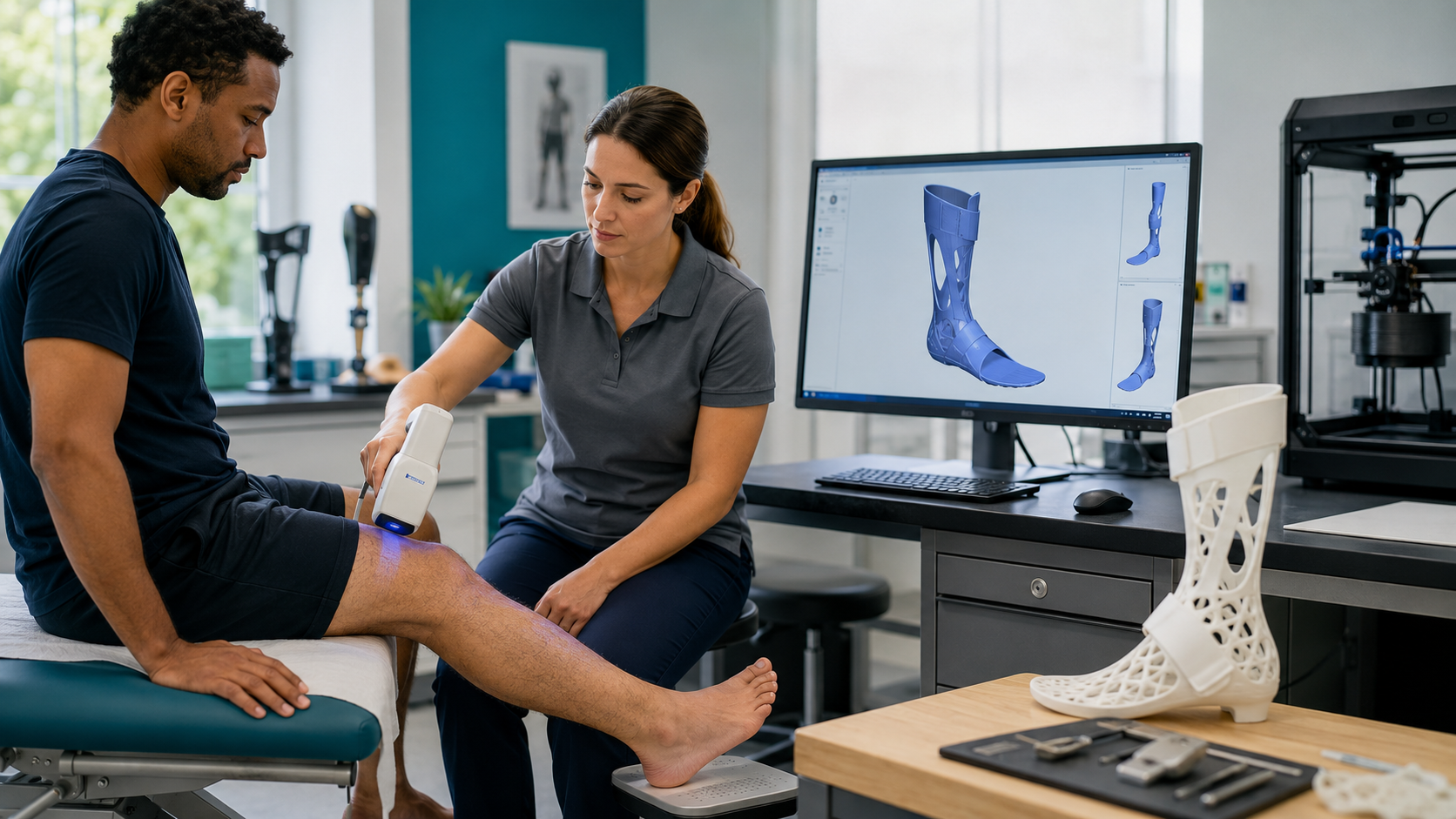
Digital Transformation in Prosthetics and Orthotics: 3D Scanning, CAD/CAM and Additive Manufacturing
Digital technology is changing how prosthetic and orthotic services capture shape, modify models, fabricate devices and manage information. These tools can improve reproducibility and workflow, but they do not remove the need for clinical assessment, biomechanical reasoning, fitting or follow-up.
A scanner captures geometry—not diagnosis, tissue tolerance, muscle strength, gait behaviour or the patient’s priorities. Technology supports clinical judgment; it does not replace it.
The Digital P&O Workflow
- Clinical assessment, prescription and definition of functional objectives.
- Shape capture using scanning, casting or measurements.
- Digital model cleaning, alignment and rectification.
- Device design with appropriate trimlines, clearances and component interfaces.
- Manufacturing by CNC carving, machining, additive manufacturing or a hybrid method.
- Finishing, assembly, structural inspection and quality control.
- Patient fitting, functional evaluation, education and follow-up.
3D Scanning
Optical scanners can record external shape without wrapping the limb in plaster. Depending on the system, this may be useful for selected lower- and upper-limb orthoses, cranial remolding, footwear, insoles, socket shapes and documentation. Scanning may reduce mess and storage demands while allowing files to be reviewed or transferred digitally.
Reliable capture still requires correct patient position, stable landmarks, appropriate exposure of the anatomy and control of movement. Reflective surfaces, loose clothing, deep contours and involuntary movement can reduce accuracy. For load-sensitive or manually corrected presentations, the clinician must determine how pressure, suspension and alignment information will be represented.
Traditional Casting Still Has Value
Plaster or fiberglass casting can provide physical control of alignment and tissue during shape capture. It may remain preferable when hands-on correction, loading or complex deformity must be incorporated. Digital and traditional methods should therefore be selected according to the clinical task rather than presented as competing technologies where one always replaces the other.
CAD/CAM and Digital Rectification
Computer-aided design allows a captured shape to be aligned, smoothed and modified. Reliefs, buildups, volume changes and trimlines can be applied systematically. Previous designs may be reviewed, duplicated or adapted when clinically appropriate. This can support consistency, training and traceability.
The danger is false precision: a model can look clean on screen while carrying an incorrect landmark, alignment or volume. Every digital modification must have a clinical reason, and the operator must understand anatomy, materials and biomechanics.
Manufacturing Options
| Method | Potential advantages | Important considerations |
|---|---|---|
| CNC-carved positive model | Works with familiar thermoforming processes and can reproduce saved geometry. | Requires suitable carving material, machinery, extraction and model finishing. |
| Direct milling or machining | Can produce precise components from selected materials. | Material waste, equipment, tooling and design limits must be considered. |
| Additive manufacturing | May enable complex geometry, variable structures, lightweight designs and distributed production. | Strength depends on material, orientation, process control, post-processing and validated design. |
| Hybrid fabrication | Combines digital shape management with proven manual materials and finishing. | Requires clear transitions, quality control and trained staff across both workflows. |
Additive Manufacturing and 3D Printing
Additive manufacturing builds an object layer by layer. In P&O, applications may include test devices, check sockets, orthoses, molds, covers, components and specialized interfaces. Materials can include thermoplastics, resins and reinforced polymers, but their clinical suitability depends on validated mechanical properties, biocompatibility, finishing and intended load.
A visually complete device may still fail through poor layer orientation, inadequate wall design, unsuitable material, weak attachment areas or inconsistent processing. Load-bearing use requires an appropriate design and documented manufacturing controls.
Potential Benefits
- Repeatable digital shape and design records.
- Reduced physical model storage.
- Faster transfer between clinic and fabrication location.
- Potential for remote collaboration and distributed manufacturing.
- Design simulation, comparison and controlled iteration.
- Opportunities for customized geometry and optimized weight.
- Data that can support training, audit and research.
Limitations and Risks
- Initial equipment, software, maintenance and training costs.
- Dependence on calibration, technical support and compatible file formats.
- Patient movement or poor positioning during scanning.
- Loss of hands-on correction information.
- Unvalidated materials or manufacturing parameters.
- Data privacy, cybersecurity and informed-consent responsibilities.
- Risk of prioritizing speed over assessment and fitting quality.
Digital Technology in Low-Resource and Remote Services
Digital workflows may support specialist collaboration across distance, reduce transport of casts and allow files to reach centralized fabrication facilities. However, technology alone cannot solve access problems. Reliable power, equipment maintenance, trained clinicians, materials, repair systems, patient travel and long-term follow-up remain essential.
Competencies for the Modern P&O Professional
Future practice requires combined clinical and technical capability: anatomy, biomechanics, material behaviour, scanning technique, digital rectification, design for manufacturing, quality assurance and data governance. A practitioner must also recognize when a conventional method is safer or more efficient.
Evaluating a Digital Workflow
Adoption should be judged using more than production speed. Services should review fit, device durability, adjustment rate, patient comfort, functional outcomes, time across the complete pathway, material use, cost, staff competency and system reliability. A faster scan does not create value if it leads to repeated fittings or early failure.
Conclusion
Digital transformation can make P&O services more connected, repeatable and innovative. Its greatest value appears when it strengthens—not weakens—the clinical pathway. The future is not simply digital or manual; it is a responsible combination of professional judgment, validated technology, skilled fabrication and patient-centred rehabilitation.
Professional references: World Health Organization and UNICEF, Global Report on Assistive Technology; World Health Organization and International Society for Prosthetics and Orthotics, Standards for Prosthetics and Orthotics. Device-specific fabrication requires validated materials, processes and applicable professional guidance.