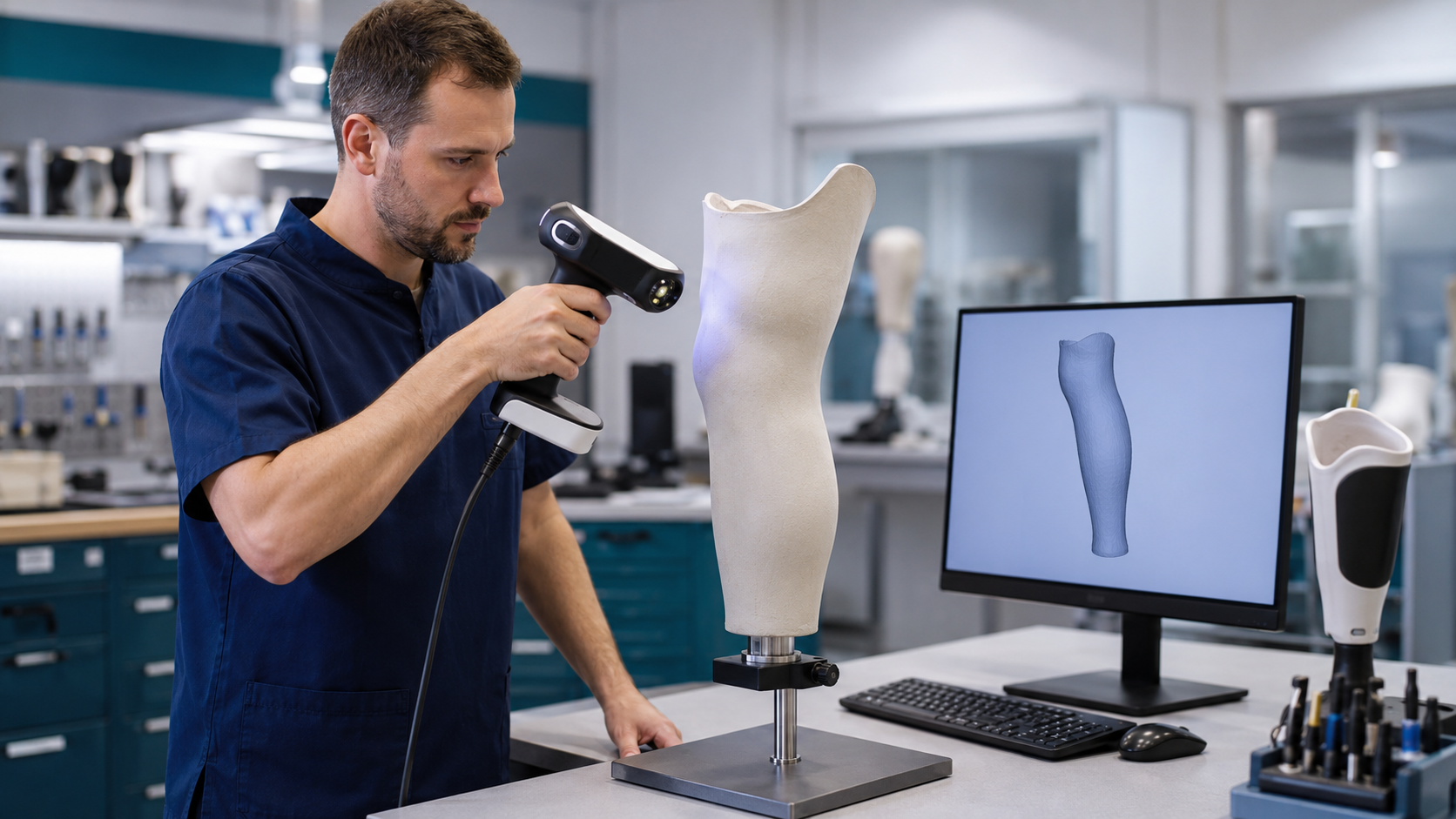
Digital Scanning and the Changing Prosthetics and Orthotics Worklab
Digital tools are changing how body shape is captured, rectified, stored and translated into prosthetic and orthotic devices. They can reduce some repetitive processes and improve reproducibility, but they do not remove the need for examination, anatomical knowledge, hands-on fitting and accountable clinical decisions.
A scan records surface shape. It does not independently identify pain, tissue tolerance, muscle control, joint stiffness, functional goals or the biomechanical correction required.
From Plaster to a Digital Workflow
A traditional pathway may include casting, model filling, rectification and forming. A digital pathway can include optical scanning, file preparation, computer-aided rectification, digital manufacturing and finishing. Many services use a hybrid workflow, selecting the method that best suits the patient, device and available expertise.
The Main Digital Stages
- Clinical assessment and prescription.
- Accurate scanning in the required position.
- File cleaning, alignment and landmark verification.
- Digital rectification and design.
- Manufacture by CNC carving, additive manufacturing or another process.
- Assembly, finishing, fitting and functional evaluation.
- Secure documentation and controlled file storage.
Potential Advantages
- Reduced plaster use and physical model storage.
- Repeatable measurements and traceable design changes.
- Faster transfer between clinic and manufacturing locations.
- Ability to duplicate or compare shapes where clinically appropriate.
- Opportunities for remote collaboration and standardized workflows.
- Potential integration with pressure, gait or outcome data.
Where Errors Still Occur
Movement during scanning, missed surfaces, poor positioning or incorrect scale can compromise the digital model. A technically clean scan may still represent the wrong alignment. Digital rectification can magnify poor clinical decisions just as efficiently as it can reproduce good ones.
Clinical Landmarks Still Matter
Landmarks guide joint location, trimlines, pressure relief and force application. They should be identified during assessment and verified after scanning. Software cannot reliably replace palpation or determine tissue tolerance from colour and surface geometry alone.
Changing Workshop Skills
The modern worklab increasingly needs skills in file handling, digital design, manufacturing parameters, machine maintenance and quality assurance. Traditional knowledge remains essential for fitting, alignment, materials, finishing, repair and recognizing when the digital output does not match the patient.
Additive Manufacturing Is Not One Material
“3D printed” describes a production process, not a single clinical property. Strength, flexibility, fatigue behaviour, surface finish and heat response depend on material, geometry, orientation and manufacturing control. A visually impressive device must still meet load, safety and durability requirements.
The clinician and service must verify that the complete device is appropriate, accurately manufactured and safe. Software output and machine completion are not final clinical quality checks.
Data, Privacy and Traceability
Scans are health-related records and should be handled securely. Services need clear naming, version control, access, backup and retention procedures. The final device should be traceable to the correct patient, prescription, design version, material and manufacturing process.
A Sensible Adoption Strategy
- Start with defined device categories and measurable goals.
- Train clinical and technical staff together.
- Validate digital results against established assessment and fitting standards.
- Record errors, remakes, time, material use and patient outcomes.
- Maintain a reliable alternative process during transition.
- Expand only when quality and service value are demonstrated.
The Future Is Hybrid and Patient-Centred
Digital and traditional techniques should not be treated as opposing identities. A service may scan one case, cast another and combine digital design with conventional finishing. The right workflow is the one that produces the safest and most effective result with appropriate use of resources.
Conclusion
Digital scanning is changing the P&O worklab from a mainly model-based environment into a connected clinical-manufacturing system. Its greatest value is not speed alone, but better traceability, communication and design control. That value is realized only when technology remains guided by clinical reasoning, skilled workmanship and patient outcomes.