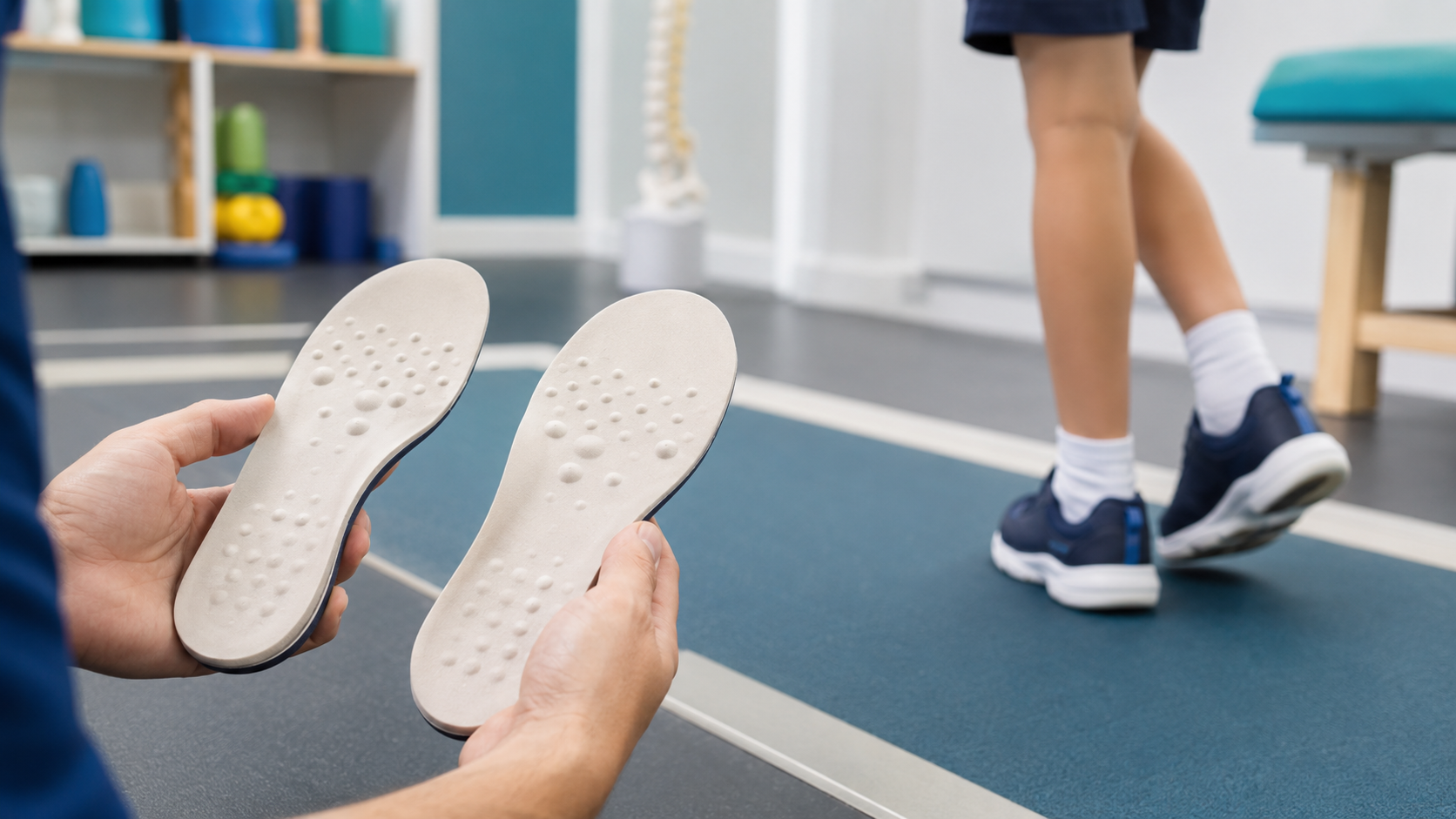
Pyramid Insoles for Idiopathic Toe Walking: Clinical Principles, Patient Selection and Limitations
Toe walking is common during early gait development, but persistent toe walking beyond the expected developmental period requires careful assessment. Some children may be diagnosed with idiopathic toe walking after neurological, orthopedic, developmental and other causes have been considered. Pyramid insoles are one conservative treatment concept described for selected children within this specific group.
Idiopathic toe walking is a diagnosis of exclusion. An insole should not be prescribed simply because a child is seen walking on the toes.
What Are Pyramid Insoles?
Pyramid insoles are custom foot orthoses incorporating strategically placed raised elements—often described as pyramid-shaped—to provide plantar input during standing and walking. The published three-step concept adjusts the orthotic configuration over time according to the child’s response. The intended approach is less restrictive than an AFO and aims to influence the gait pattern while allowing ordinary footwear and daily activity.
Why Children Toe-Walk
Toe walking is a gait description, not a final diagnosis. Possible contributors include:
- Idiopathic or habitual toe walking.
- Cerebral palsy or another upper motor neuron condition.
- Muscular dystrophy, neuropathy or muscle weakness.
- Autism spectrum condition or sensory-processing differences.
- Shortened gastrocnemius–soleus complex or fixed ankle equinus.
- Foot deformity, pain or compensation for another biomechanical problem.
- Spinal, developmental or orthopedic conditions requiring further investigation.
Assessment Before Treatment
| Assessment area | Clinical questions |
|---|---|
| History | When did toe walking begin? Is it unilateral or bilateral? Can the child walk heel-to-toe when asked? |
| Range of motion | Is ankle dorsiflexion available with the knee flexed and extended? Is the limitation flexible or fixed? |
| Neurological status | Are tone, reflexes, strength, coordination and developmental history appropriate? |
| Foot and lower-limb alignment | Is there midfoot collapse, cavus, valgus, varus, rotational difference or limb-length concern? |
| Gait | How frequent and severe is the pattern? What happens at the ankle, knee, hip and trunk? |
| Function and participation | Does the pattern affect balance, fatigue, pain, running, stairs, school or play? |
| Footwear and skin | Is there enough internal space, secure fastening and a safe interface for the insole? |
Possible Indications
A pyramid insole concept may be considered by an appropriately trained clinician when:
- The child has undergone assessment and idiopathic toe walking is the working diagnosis.
- The gait pattern is flexible and the child has adequate passive ankle range for the intended plan.
- A less restrictive intervention is clinically reasonable.
- The child and family can follow the wearing, footwear and review schedule.
- Skin, sensation and communication allow safe monitoring.
- Clear baseline findings and measurable goals are documented.
Contraindications and Reasons for Caution
Pyramid insoles should not be treated as a universal solution. They may be inappropriate or require specialist reconsideration when there is:
- Undiagnosed unilateral or progressive toe walking.
- A fixed contracture that prevents the intended heel contact.
- Significant neurological signs, weakness or abnormal tone.
- Marked foot deformity, instability or pain.
- Active skin injury, severe sensory loss or inability to monitor pressure.
- A need for stronger plantarflexion, ankle or knee control than a foot orthosis can provide.
- Poor tolerance of the raised elements despite appropriate adjustment.
Regression, weakness, frequent falls, asymmetry, pain, loss of skills, abnormal reflexes, progressive tightness or toe walking that begins after a period of typical heel-to-toe gait requires medical evaluation.
Footwear and Fitting
The insole must lie flat inside a stable shoe with adequate width, depth and secure fastening. The original removable liner may need to be removed according to the fitting plan. Pressure over each raised element, heel position, toe space and gait response should be checked. A device that crowds the shoe or creates persistent focal redness is not a successful fit.
Follow-Up and Outcome Measures
Follow-up should consider more than whether toe walking is still visible. Useful outcomes include frequency of heel contact, ankle range, walking endurance, balance, falls, comfort, skin response, participation and family-reported adherence. Video or structured gait observation under consistent conditions can help document change.
When an Insole May Not Be Enough
Some children require physiotherapy, stretching or strengthening, serial casting, an SMO or AFO, medical investigation or multidisciplinary management. An AFO may be more appropriate when stronger control of plantarflexion, ankle position or knee mechanics is required. Treatment should match the cause and severity rather than progress automatically through a fixed device sequence.
What Does the Evidence Say?
A published report described a three-step pyramid-insole concept for idiopathic toe walking and reported improvement in a treated group. However, the available evidence is limited and does not establish that the approach is superior for every child. Clinical decisions should combine current evidence, professional judgement, individual presentation and family goals.
Conclusion
Pyramid insoles may provide a useful, relatively low-profile option for selected children with carefully assessed idiopathic toe walking. Their safe use depends on diagnosis, available range, correct fabrication, compatible footwear, gradual introduction and objective follow-up. The aim is not simply to force the heel down, but to support a safer and more sustainable gait pattern while respecting the child’s comfort and function.
Selected reference: Pomarino D, Ramírez-Llamas J, Pomarino A. The 3-Step Pyramid Insole Treatment Concept for Idiopathic Toe Walking. This article is educational and does not replace pediatric neurological, orthopedic or gait assessment.