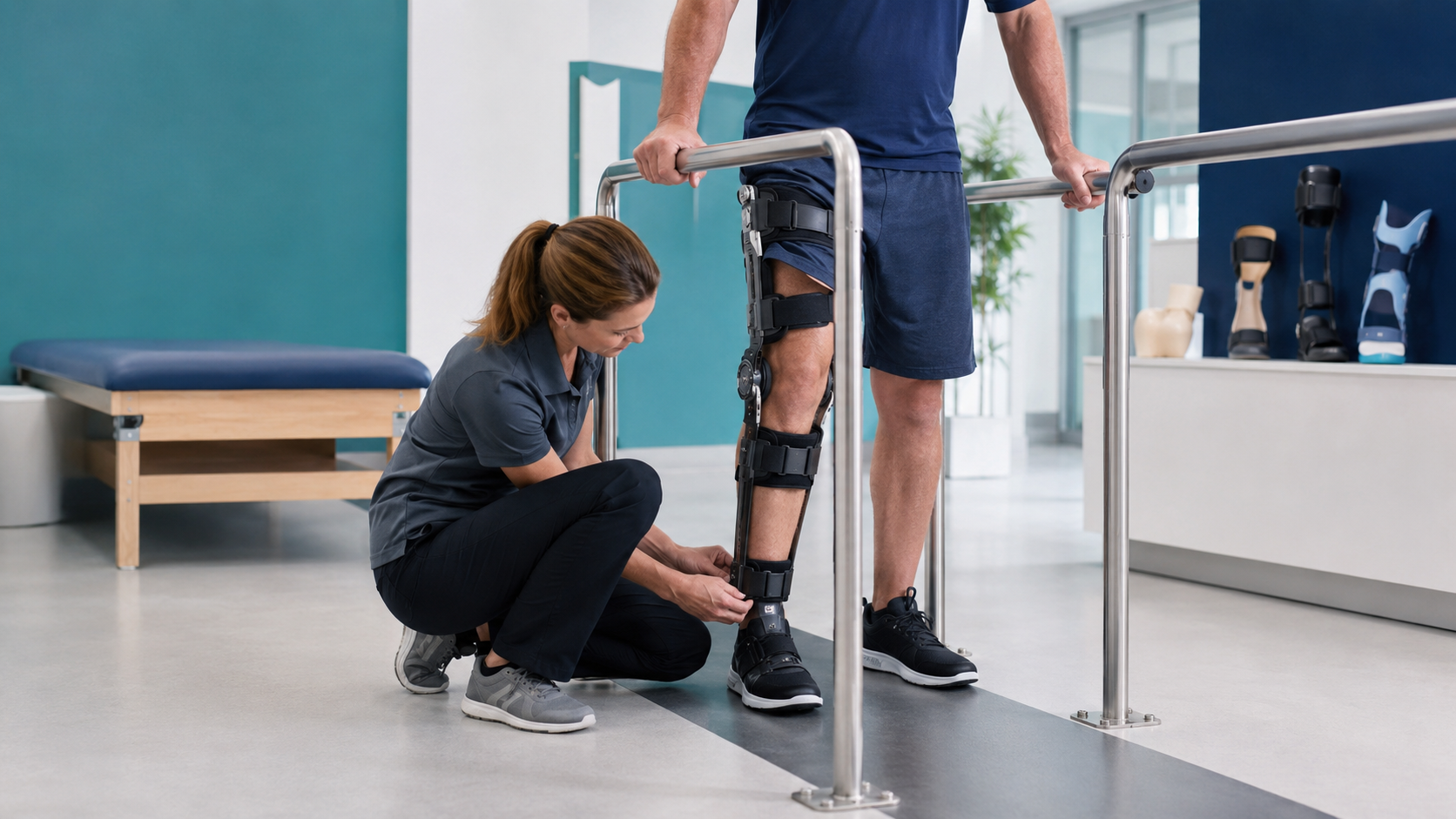
Understanding Knee-Ankle-Foot Orthoses (KAFOs)
A KAFO is an orthosis that spans the knee, ankle and foot. It may improve stability, control unwanted movement, support weak muscles, protect joints and make standing or walking safer for selected individuals.
A KAFO should be prescribed from a full assessment. The diagnosis alone does not determine the design; muscle strength, joint range, alignment, sensation, goals and gait all matter.
Who May Benefit?
KAFOs may be considered when an AFO alone cannot provide sufficient knee control. Examples include significant weakness or paralysis, neuromuscular conditions, poliomyelitis, spinal cord injury, peripheral nerve injury, severe knee instability and selected deformities. A KAFO may also be used for protection or positioning when clinically indicated.
Main Design Options
Locked-knee KAFO
The knee joint is locked for stance stability and released for sitting. It can be reliable but may require compensatory walking strategies and additional energy.
Free or limited-motion knee joint
This permits selected motion when the person has enough control and the orthosis can safely guide or limit the knee.
Offset or posteriorly positioned joints
Mechanical alignment can encourage stability in stance, but suitability depends on the person’s anatomy, contracture and ground-reaction forces.
Stance-control KAFO
A stance-control design aims to resist knee flexion during stance while allowing knee flexion during swing. It may improve some aspects of gait for carefully selected users, but it requires appropriate range, strength, control, training and maintenance.
Custom Versus Prefabricated
Custom devices are shaped from measurements, casting or scanning and can address complex alignment and pressure needs. Prefabricated devices may be appropriate for temporary or less complex requirements. Material options include thermoplastic, metal-leather and composite structures, selected according to control, weight, adjustability and the user’s circumstances.
Assessment and Alignment
- Hip, knee and ankle range of motion
- Muscle strength, tone and motor control
- Coronal and sagittal alignment
- Leg length and skeletal deformity
- Skin, sensation, circulation and swelling
- Balance, cognition, upper-limb function and use of walking aids
- Footwear, home and community environment
The ankle section influences the knee through ground-reaction forces. Small alignment changes can therefore affect stability, comfort and gait.
Fitting and Training
At delivery, the orthotist checks pressure, strap position, joint alignment, clearance, footwear and the device’s function during standing and walking. Physiotherapy may be needed for transfers, balance, gait, stairs and safe use of aids. Wearing time is usually increased gradually according to the clinical plan.
Skin Care and Maintenance
- Inspect the skin before and after wear.
- Use the specified socks, interface and footwear.
- Keep joints and straps clean; follow lubrication instructions.
- Do not bend uprights or alter locks yourself.
- Arrange review for growth, weight change, new weakness or altered gait.
- Skin breakdown, blistering or redness that does not settle
- New numbness, swelling, severe pain or color change
- A knee lock that fails to engage or release correctly
- Loose joints, cracked plastic, broken straps or unusual noise
- Repeated trips, falls or loss of confidence
Benefits and Limitations
A well-designed KAFO may improve stability, alignment, safety and participation. However, it can add weight and bulk, require suitable footwear and increase effort. Evidence for advanced designs varies by diagnosis and outcome, so observed function and the user’s experience should guide follow-up.
This article is educational and does not replace individual orthotic assessment, prescription or gait training.
References: North Bristol NHS: KAFO; Systematic review of stance-control KAFOs.