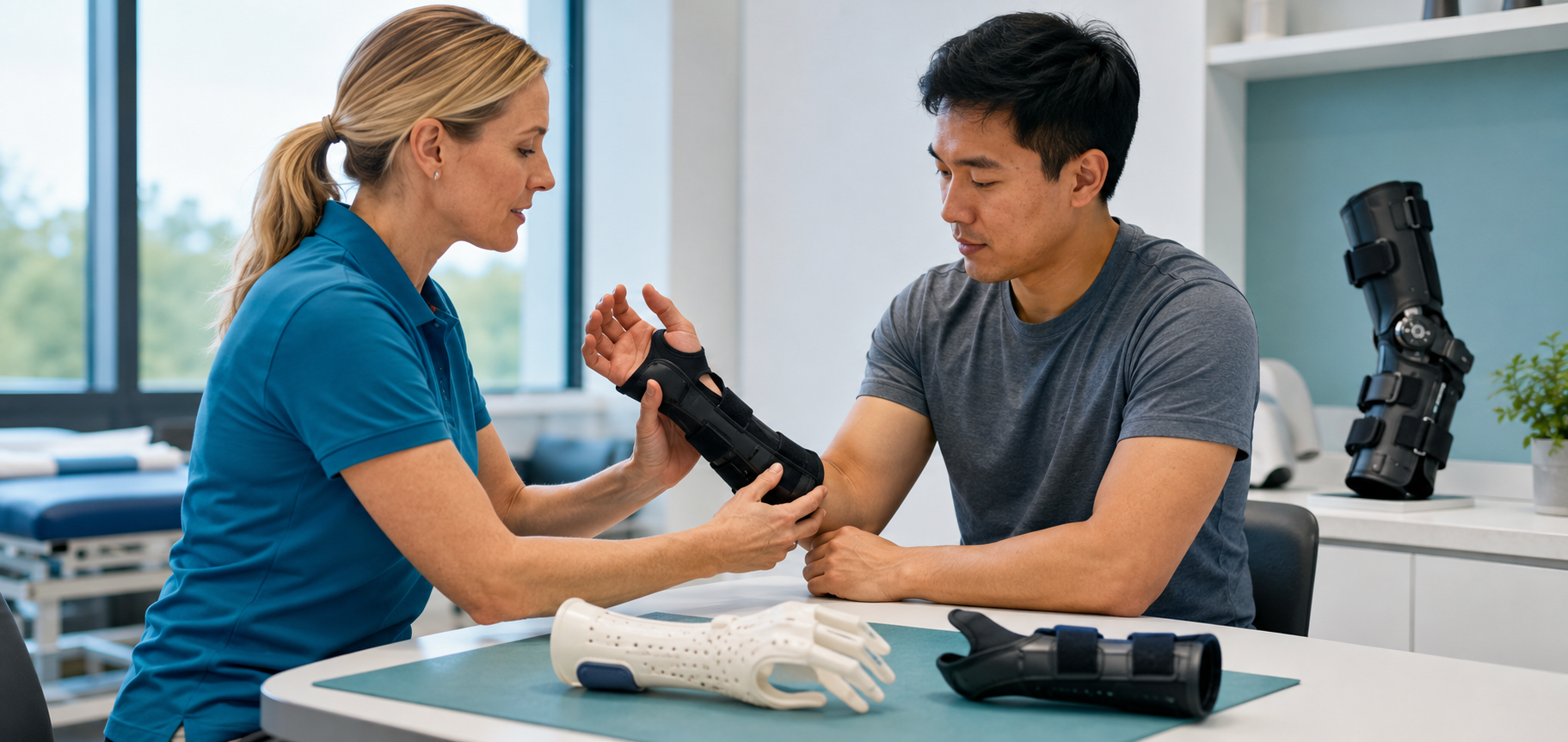
Upper-Limb Orthoses: Clinical Management of the Elbow, Wrist, Hand and Thumb
The upper limb supports personal care, work, communication, mobility aids and countless daily tasks. Pain, weakness, deformity or injury can make these activities difficult. An upper-limb orthosis may protect healing tissue, reduce pain, maintain alignment, prevent contracture or improve functional positioning—but only when its design matches a clearly defined clinical goal.
The least restrictive orthosis that safely achieves the required goal usually supports better comfort, movement and adherence.
What Are Upper-Limb Orthoses?
Upper-limb orthoses are externally applied devices for the elbow, forearm, wrist, hand, thumb or fingers. They may be static, allowing little or no movement; dynamic, applying a controlled mobilizing force; or functional, positioning joints to make a task easier. Some are worn temporarily after injury, while others support long-term neurological or musculoskeletal conditions.
Assessment Before Selection
A prescription should be based on more than the diagnosis. The orthotist considers:
- Pain, swelling, skin integrity, sensation and circulation.
- Active and passive range of motion, joint stability and muscle strength.
- Tone, spasticity, contracture risk and motor control.
- Healing precautions following fracture, tendon repair or surgery.
- Hand dominance, occupation, self-care and functional priorities.
- The ability to apply, remove, clean and monitor the orthosis.
Common Orthotic Categories
| Orthosis | Typical goals | Examples of clinical use |
|---|---|---|
| Elbow orthosis | Protect, immobilize or limit flexion and extension. | Selected fractures, postoperative protection, instability, contracture management or controlled range. |
| Wrist orthosis | Support the wrist while leaving the fingers available. | Wrist pain, selected tendon conditions, arthritis, nerve irritation and functional positioning. |
| Wrist-hand orthosis | Position the wrist and hand, protect tissue or reduce deforming forces. | Neurological weakness, trauma, arthritis, burns and contracture prevention. |
| Thumb-spica orthosis | Stabilize the thumb while permitting selected finger and wrist function. | Thumb-joint pain, ligament injury, osteoarthritis and tendon irritation. |
| Finger orthosis | Protect or mobilize a specific joint and guide alignment. | Sprains, fractures, tendon injury, deformity and postoperative protocols. |
Static, Dynamic and Progressive Designs
Static Orthoses
A static orthosis holds a joint in a chosen position. It may rest painful tissues, protect repair or maintain length. “Static” does not mean simple: small changes in wrist angle, thumb position or pressure distribution can significantly affect comfort and hand function.
Dynamic Orthoses
Dynamic designs use elastic elements, springs or outriggers to assist movement or apply a controlled force. Their direction, magnitude and line of pull require careful construction and frequent review.
Static-Progressive Orthoses
These apply a non-elastic, adjustable force to improve restricted range gradually. They depend on tissue tolerance and a prescribed wearing schedule. More force is not necessarily more effective and can provoke pain or inflammation.
Custom-Made or Prefabricated?
Prefabricated orthoses can provide timely support when the available sizes and design match the person’s anatomy and goal. Custom fabrication is valuable for unusual anatomy, complex positioning, sensitive skin, precise postoperative requirements or when standard products do not distribute pressure adequately. The correct choice is the device that provides the required control safely—not automatically the most complex option.
Fit and Pressure Management
Upper-limb anatomy includes superficial nerves, bony prominences and areas vulnerable to pressure. Edges should be smooth, straps should secure without constricting, and the palm should remain usable whenever the prescription permits. The fit should be checked during the activities for which the orthosis is intended.
- Confirm that the wrist, thumb and fingers are held at the prescribed angles.
- Avoid concentrated pressure over the ulnar styloid, radial styloid and prominent joints.
- Check circulation, sensation and swelling before and after fitting.
- Ensure straps do not migrate or create a tourniquet effect.
- Verify that the orthosis does not unnecessarily block useful grasp or pinch.
Wearing Schedule and Patient Education
Wearing time depends on the condition, tissue status and clinical goal. A protective postoperative orthosis follows the surgeon’s protocol; a resting orthosis may be used at selected times; a functional device may be worn during specific activities. Instructions should cover application, strap sequence, skin inspection, cleaning and when to stop use.
Increasing pain, persistent redness, numbness, colour change, swelling, skin injury, a broken component or loss of the intended position requires prompt review. Structural heating, cutting or bending should not be attempted without professional guidance.
Orthoses Within Rehabilitation
An orthosis can protect or position the limb, but it does not replace therapy. Depending on the diagnosis, the wider plan may include exercise, oedema control, scar management, sensory re-education, task practice and medical or surgical care. Coordination among the patient, physician, therapist and orthotist helps ensure that the device supports rather than obstructs rehabilitation.
Conclusion
Effective upper-limb orthotic care begins with a specific goal and a detailed understanding of anatomy, tissue tolerance and daily function. Whether the device is a simple wrist support or a custom dynamic orthosis, careful selection, fitting, education and follow-up determine its real clinical value.
Educational note: This article provides general information and does not replace individual examination, diagnosis, surgical precautions or an orthotic prescription.