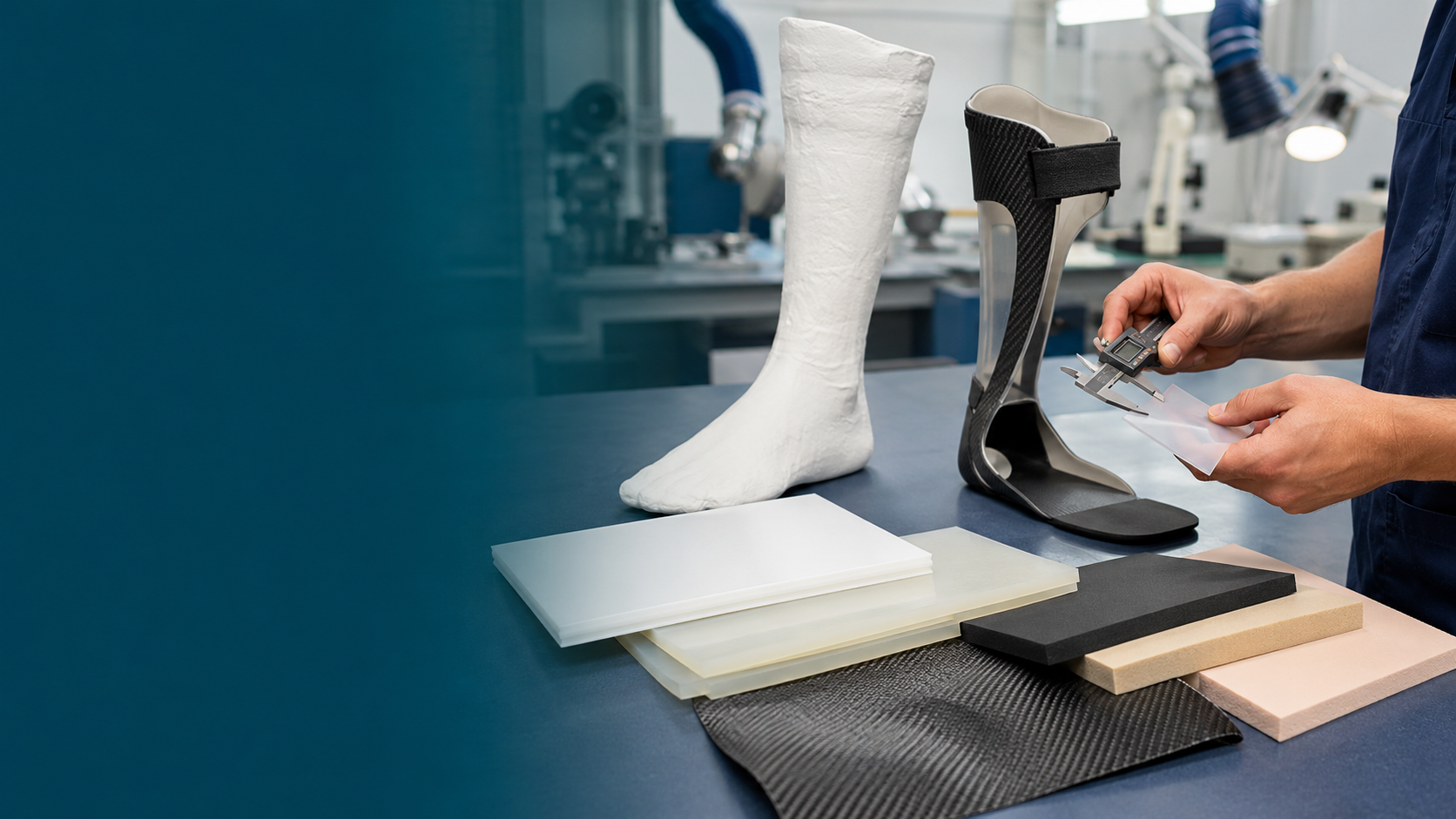
Material Selection in AFO Fabrication: PPH, PPC, EVA and Carbon Fiber
In an orthotics workshop, material selection is not simply a choice between an older material and a newer one. It is a clinical and technical decision that influences control, flexibility, comfort, weight, durability, adjustability and the fabrication process.
The same AFO design can behave very differently when the material type, thickness, trimlines or reinforcement are changed. For this reason, the workshop must translate the clinical prescription into a device that provides the intended mechanical effect while remaining safe and practical for the patient.
The best material is not the most expensive or the most advanced. It is the material that provides the required control and comfort for the individual patient and can be fabricated, fitted and followed up safely.
Start with the Clinical Requirement
Before choosing a sheet or composite, the clinical and workshop teams should understand what the AFO needs to achieve. Important considerations include:
- Diagnosis, muscle strength and muscle tone
- Passive ankle range and fixed deformity
- Required control in the sagittal, coronal and transverse planes
- Patient weight, activity level and expected loading
- Skin condition, sensation and pressure tolerance
- Footwear, daily environment and cosmetic priorities
- Whether future heat modification or adjustment is likely
PPH: Polypropylene Homopolymer
PPH is commonly selected when relatively firm structural control is needed. It can provide a useful balance between rigidity, weight and thermoformability. Depending on thickness and trimlines, it may be used for solid AFOs, ground-reaction designs and other orthoses requiring controlled deformation.
Workshop strengths
- Good rigidity-to-weight relationship
- Suitable for vacuum forming
- Can be trimmed and locally heat-adjusted
- Available in multiple thicknesses
Points to monitor
- May feel too stiff if overbuilt
- Stress can concentrate near narrow trimlines
- Forming temperature and cooling affect quality
- Edges require careful finishing
PPC: Polypropylene Copolymer
PPC generally offers greater impact resistance and flexibility than homopolymer polypropylene. In practice, it can be useful when an AFO needs more controlled flexibility or when the workshop wants to reduce brittle behavior under repeated loading. Exact properties vary between suppliers and grades, so the manufacturer’s technical data should always be checked.
Greater flexibility does not automatically mean better function. If the material, thickness or trimlines allow excessive movement, the AFO may fail to provide the control specified by the clinician.
EVA for Cushioning and Interface Management
Ethylene-vinyl acetate, commonly known as EVA, is available in different densities and thicknesses. It may be used for padding, pressure redistribution, posting, footbeds, straps or selected inner interfaces. Softer EVA improves cushioning and conformity, while firmer grades can provide more durable support.
- Choose density according to the required cushioning and stability.
- Avoid adding bulk that makes footwear difficult to fit.
- Skive transitions smoothly to reduce edge pressure.
- Consider heat, perspiration, hygiene and replacement needs.
Plastazote and Other Soft Linings
Plastazote is a closed-cell polyethylene foam often used where a soft, lightweight and heat-moldable interface is helpful. It can be valuable for sensitive skin and pressure accommodation, but it may compress with use. The workshop should select an appropriate density, bond it securely and plan for inspection or replacement when necessary.
A soft lining cannot compensate for a poorly shaped orthosis. Relief, total contact, alignment and trimlines must first be correct.
Carbon Fiber Composite
Carbon fiber composites can create thin, lightweight structures with high strength and carefully designed stiffness. Dynamic designs may store and return part of the energy applied during walking. However, their performance depends on fiber orientation, laminate design, geometry, resin system and manufacturing quality—not on the appearance of carbon weave alone.
Potential advantages
- Low weight and slim profile
- High strength relative to weight
- Possibility of dynamic response
- Consistent engineered stiffness
Important limitations
- Limited post-fabrication heat adjustment
- Specialized materials and processes
- Higher cost in many settings
- Damage or delamination requires expert review
Thickness, Trimlines and Geometry Matter
Material name alone does not define stiffness. A thicker sheet, wider ankle section or higher trimline may provide greater resistance. A narrow posterior section or flexible trimline may allow more movement. Corrugations, joints, reinforcements and footplate length further change the response.
This is why good communication between the prescribing clinician and fabrication team is essential. The workshop needs more than “make an AFO”; it needs the intended ankle control, knee effect, range, activity demand and areas requiring protection.
A Practical Workshop Selection Process
- Clarify the prescription: Understand the functional goal and required control.
- Review patient factors: Weight, activity, skin, sensation, alignment and expected growth or volume change.
- Select the material family: Thermoplastic, soft interface, composite or a combination.
- Choose grade and thickness: Match mechanical demand and fabrication method.
- Plan trimlines and reinforcement: Build stiffness where needed while avoiding unnecessary bulk.
- Follow controlled fabrication: Use correct heating, vacuum, curing, bonding and cooling procedures.
- Finish and inspect: Smooth edges, confirm symmetry and check for stress risers or defects.
- Evaluate clinically: Final fitting and gait assessment determine whether the intended result was achieved.
Thermoforming, grinding, carbon-composite work and adhesive use require appropriate ventilation, machine guarding, dust extraction and personal protective equipment. Carbon dust and resin systems must be managed according to their safety data sheets and local workplace procedures.
What I Value in Workshop Practice
Material selection works best when clinical reasoning and fabrication experience meet at the workbench. A technically beautiful orthosis is not successful if it does not meet the patient’s functional need. Likewise, a sound prescription can fail if thickness, trimlines, pressure relief or finishing are not executed properly.
The most reliable approach is a shared process: assess, prescribe, fabricate, fit, observe, adjust and follow up. Each completed AFO should teach the team something that improves the next one.
Key Takeaways
- PPH is often selected for firmer structural control.
- PPC can offer greater flexibility and impact resistance, depending on grade.
- EVA and Plastazote help manage cushioning and the patient interface.
- Carbon fiber can provide a thin, lightweight engineered response but is less adjustable.
- Thickness, trimlines and geometry are as important as the material name.
- Final clinical fitting confirms whether the workshop choice achieved the intended outcome.
This workshop blog shares general professional experience and education. Material specifications, fabrication procedures and clinical decisions should follow qualified assessment, supplier data and workplace safety protocols.