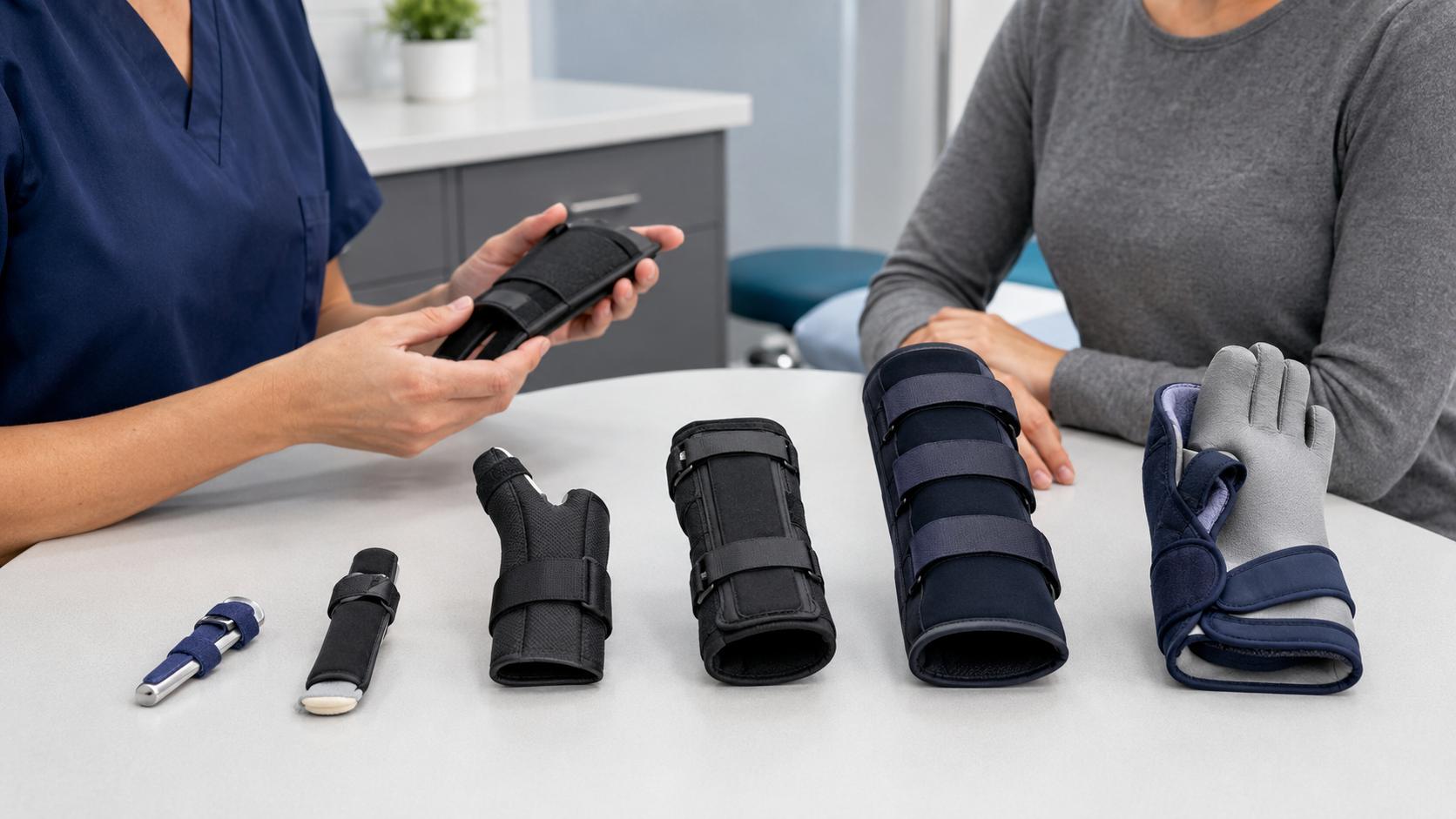
From Finger Splints to Wrist-Hand Supports: Selecting Prefabricated Upper-Limb Orthoses
Prefabricated upper-limb orthoses can provide timely protection, pain relief and functional support. The range is extensive: a small finger splint may control one interphalangeal joint, while a wrist-hand or elbow-wrist-hand device may influence several segments. Choosing from this range requires more than matching a product name to a diagnosis.
Select the least restrictive prefabricated orthosis that safely achieves the defined clinical goal and still permits useful function.
Begin with the Intended Outcome
Before selecting a device, define whether the aim is to immobilize, protect healing tissue, reduce pain, limit one direction, assist movement, prevent contracture or position the hand for function. The same diagnosis can require different orthoses at different stages of recovery.
Finger Orthoses
Finger devices may include mallet-finger splints, PIP extension or flexion control, buddy straps, oval-style rings and fracture-protection splints. Selection depends on the exact joint, tissue involved, required angle and medical protocol. A small device can still cause pressure, swelling or stiffness if fitted incorrectly.
Thumb Orthoses
Short thumb supports may stabilize the MCP or CMC region while leaving the wrist relatively free. Longer thumb-spica designs also include the wrist. The clinician checks which thumb joints must be controlled, whether pinch must remain available and whether the first web space is protected from pressure.
Wrist Orthoses
Neutral wrist braces are frequently used for selected pain conditions, overuse, nerve irritation or injury protection. The metal or plastic stay must be contoured appropriately and should not force an unsuitable wrist angle. The distal edge should allow finger flexion and avoid obstructing the palmar crease unnecessarily.
Wrist-Hand and Resting-Hand Orthoses
Wrist-hand orthoses may support neurological positioning, contracture management, arthritis or trauma. Prefabricated resting-hand designs require careful attention to wrist angle, finger position, thumb alignment and pressure over the metacarpal heads. A “universal” shape does not fit every hand.
Elbow and Combined Orthoses
Prefabricated elbow braces may immobilize, limit range or provide controlled motion. Combined elbow-wrist-hand devices provide greater coverage but also increase weight, heat and complexity. Joint alignment and medical restrictions are especially important when hinged components are used.
Selection Checklist
- Confirm diagnosis, side and clinical objective.
- Check pain, swelling, skin, sensation and circulation.
- Measure according to the manufacturer’s current sizing method.
- Select the required joints and movements—no more and no less.
- Check right/left orientation and whether the product is truly reversible.
- Consider work, hygiene, transfers, mobility aids and self-care.
- Confirm that the patient or caregiver can apply it correctly.
When Prefabricated Is Not Enough
Custom fabrication may be preferred for unusual anatomy, major deformity, precise postoperative positioning, significant pressure risk, complex tone or when standard sizing cannot maintain the required alignment. Repeatedly forcing or over-padding an unsuitable prefabricated orthosis is not a substitute for a custom design.
Fractures, tendon repairs, ligament injuries and postoperative conditions may require exact positioning and range restrictions. Product selection must follow the treating team’s precautions rather than general assumptions about the diagnosis.
My Workshop Reflection
Prefabricated does not mean non-clinical. Good outcomes still depend on assessment, correct sizing, fitting, education and review. The value of the device lies not in how many straps or features it has, but in whether it protects the intended structure while preserving safe and meaningful hand use.
This blog shares general professional experience and does not identify any patient, workplace, brand or organization.