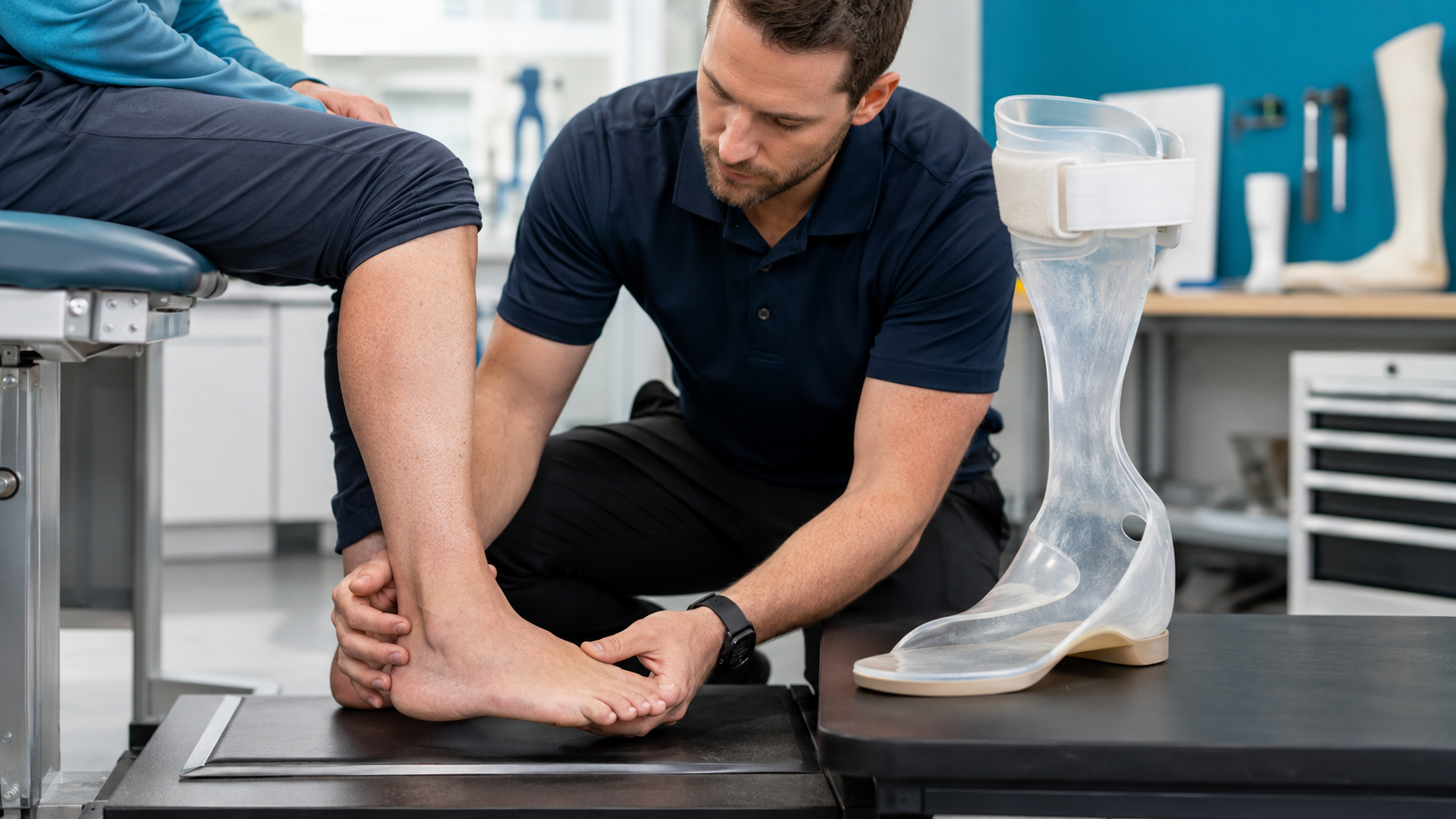
Midfoot and Hindfoot Control in AFOs: Why Important Modifications Are Often Invisible
An ankle-foot orthosis is often judged by its ankle angle, joints, straps and external appearance. Yet much of its ability to control the foot is created quietly within the heel pocket, plantar contour, trimlines and relationship with the shoe. These features may not look like separate modifications, but they determine whether the AFO controls the hindfoot and midfoot or simply surrounds them.
Effective foot control begins with assessment and shape capture. It is built into casting position, model rectification, total-contact molding, trimlines and footplate design—not added automatically as a visible pad or wedge.
Understanding the Regions
| Region | Main structures | Common control concerns |
|---|---|---|
| Hindfoot | Calcaneus, talus and subtalar complex | Valgus, varus, inversion, eversion and instability. |
| Midfoot | Talonavicular, calcaneocuboid and arch structures | Collapse, abduction, adduction, pronation, supination and pressure. |
| Forefoot | Metatarsals, rays and toes | Alignment, loading, lever arm, rollover and accommodation. |
The regions interact. A valgus calcaneus may accompany medial midfoot collapse and forefoot abduction. A cavovarus presentation may combine hindfoot varus, a high arch and lateral instability. The prescription must identify where the deformity begins, how flexible it is and which segment should be guided, contained or accommodated.
Not Every AFO Provides the Same Foot Control
A posterior leaf-spring AFO may primarily assist swing-phase clearance and provide limited mediolateral containment. A slim carbon foot-drop AFO may also offer little custom hindfoot or midfoot correction. A close-fitting solid AFO, SMO-style design, total-contact system or custom inner boot can provide stronger triplanar control when properly prescribed and fabricated.
The name “AFO” therefore does not guarantee a specific amount of subtalar or midfoot control. Design, material, trimlines, fit and footwear determine the actual result.
Why the Modifications May Be Invisible
- The foot was held in a selected position during casting.
- Manual correction was incorporated into the negative impression.
- The positive model was rectified to create broad control surfaces.
- The heel pocket was closely defined around the calcaneus.
- The plantar surface was shaped for total contact.
- Medial and lateral walls were retained to create lever arms.
- The footplate length and stiffness were selected for the required control.
- The shoe completed the containment and alignment system.
Hindfoot Control
Close Calcaneal Containment
A precise heel pocket helps centre the calcaneus and limits movement within the AFO. If the heel section is broad or poorly defined, the calcaneus can move even when the ankle portion appears rigid. Calcaneal containment must avoid focal pressure at the posterior heel and malleoli.
Medial and Lateral Control Surfaces
Higher sidewalls and appropriate supramalleolar trimlines create longer lever arms for resisting inversion or eversion. Broad contact distributes force more safely than a small pressure point. The forces act as a system: one region guides the hindfoot while counterforces stabilize the opposite side and plantar surface.
Heel Posting and Wedging
Medial or lateral posting may be considered when supported by assessment. Posting the AFO footplate can tilt the entire orthosis and its leg section, affecting tibial alignment and knee mechanics. A wedge must therefore be evaluated during standing and walking with the intended footwear.
Strap and Heel Seating
An instep or ankle strap can help seat the calcaneus fully into the heel pocket. If the heel lifts, the intended control surfaces no longer contact the correct anatomy. A strap supports good geometry; it cannot rescue an incorrectly shaped heel section.
Midfoot Control
Medial Arch Contour
A broad plantar contour can support load distribution and limit excessive midfoot collapse. The aim is not to create a narrow arch lump. Excessive localized pressure may cause pain or rejection, particularly around a prominent navicular.
Navicular Support and Relief
The medial wall may be retained to improve containment while a specific relief protects the navicular. Support and relief can coexist: the surrounding surfaces provide control while the prominence is protected from focal pressure.
Lateral Midfoot Containment
Coverage near the cuboid and lateral midfoot can contribute to controlling adduction, supination or lateral instability. Its position must coordinate with medial and plantar counterforces. Cutting this area low for easier donning or appearance may reduce the intended lever arm.
Medial and Lateral Flanges
A flange increases contact area and lever arm on one side of the foot. A medial flange may be used in selected presentations involving midfoot collapse or abduction; a lateral flange may contribute in selected supination or adduction patterns. The force system, not the flange name alone, determines whether it is appropriate.
Footplate Length and Stiffness
A full-length footplate provides a longer lever arm and greater opportunity to influence forefoot loading than a short design. Footplate stiffness can also alter rollover and push-off mechanics. The footplate should be treated as an active biomechanical part of the AFO rather than a simple base beneath the foot.
Corrective or Accommodative?
A flexible deformity may be guided toward a more functional position using corrective casting, total-contact molding and an appropriate pressure system. A rigid deformity should not be forced to an anatomical neutral position that the patient cannot tolerate.
Aggressive correction can create pressure over the malleoli, navicular, fifth metatarsal base, calcaneus or other prominences. For rigid deformity, the goal may be accommodation, partial correction, pressure distribution and improved stability.
Why Foot Control Sometimes Fails
- The deformity was not assessed as flexible, partially correctable or fixed.
- The corrected position was lost during casting or model rectification.
- The heel pocket is too wide or the heel lifts during gait.
- Trimlines were reduced below the level needed for containment.
- The selected material or footplate is too flexible.
- The navicular, cuboid or forefoot lacks the required control surface.
- The shoe is too soft, too wide or unable to contain the AFO.
- The deformity exceeds what the chosen AFO design can control safely.
Assessment Before Modification
- Identify the primary segment and direction of deformity.
- Determine whether it is flexible, partly correctable or fixed.
- Assess ankle range, subtalar movement, forefoot relationship and skin risk.
- Observe standing, gait, knee behaviour and proximal compensation.
- Define the desired correction or accommodation.
- Select the design, material, trimlines, footplate and footwear as one system.
- Check pressure, comfort and function during fitting and follow-up.
The Effect on the Knee and Whole Limb
Changing hindfoot position, footplate posting or AFO alignment can alter tibial progression and the direction of the ground-reaction force. This may affect knee flexion, extension, varus, valgus, hip rotation and balance. Midfoot and hindfoot modifications must therefore be evaluated with the complete AFO–footwear combination during functional activity.
Conclusion
Midfoot and hindfoot control is often present without an obvious external addition. It is created through precise assessment, casting, rectification, total-contact molding, sidewall retention, footplate design and footwear. Understanding these less-visible features helps clinicians and technicians distinguish an AFO that merely fits around the foot from one that provides purposeful biomechanical control.
Professional references: The AFO and Ankle Control; Uses of Braces and Orthotics for Conservative Management of Foot and Ankle Disorders; Huang et al., Effects of AFOs on ankle and foot kinematics in subtalar osteoarthritis; Kerkum et al., Effects of footplate stiffness on push-off power.